
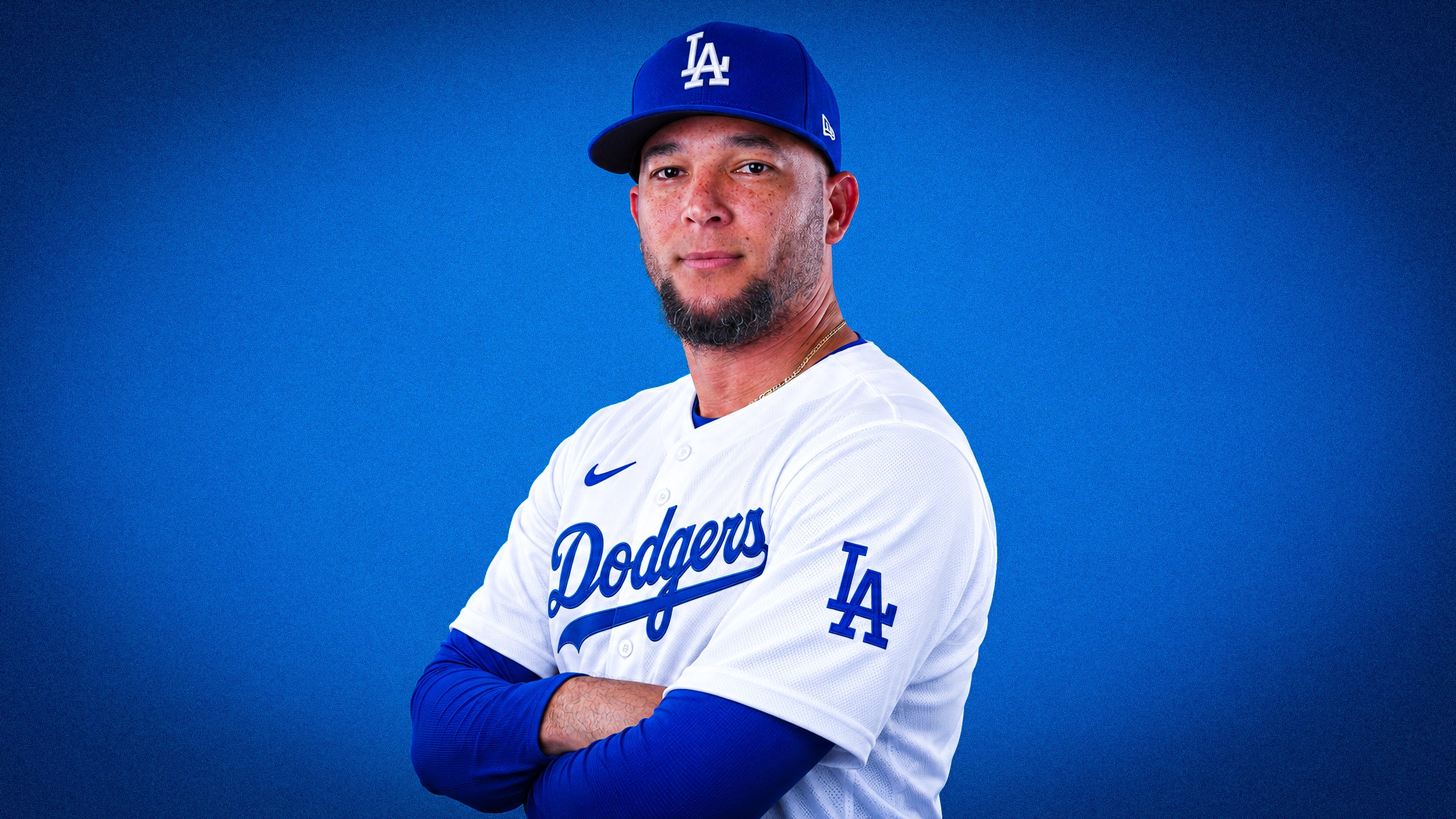
Pedro Guerrero’s return to the Dodgers is about more than filling the position Aaron Bates left behind.
Guerrero brings experience working with both established Major League hitters and young players still developing their offensive identities. He has coached in multiple organizations, spent the past two seasons leading Miami’s hitting staff and already understands parts of the Dodgers’ organizational culture.
Los Angeles officially hired the 37-year-old to work alongside Robert Van Scoyoc as a Major League hitting coach.
The exact division of responsibilities between Guerrero, Van Scoyoc and game-planning and communication coach J.T. Watkins has not been finalized. Brandon Gomes described the structure as collaborative rather than one coach operating above the others.
That distinction matters.
Guerrero is not arriving with instructions to replace the Dodgers’ existing offensive philosophy. He is joining the group to provide another perspective, improve communication and help Los Angeles identify why its offense repeatedly lost consistency during the second half of the season.
Guerrero Is Returning To The Organization Where His Career Began
This is not Guerrero’s first experience with the Dodgers.
Los Angeles signed him as an international free agent out of San Pedro de Macorís, Dominican Republic, in 2006. He spent eight seasons in the Dodgers’ minor-league system, playing 411 games from 2006 through 2013.
Guerrero was a versatile infielder who appeared primarily at shortstop, third base and second base. He finished his playing career with a .236 average, 23 home runs and 163 RBIs, briefly reaching Triple-A Albuquerque.
He returned to the organization as bench coach for the Rookie-level Ogden Raptors in 2016 and 2017 before moving into Major League hitting instruction.
For clarity, this is not the Pedro Guerrero who starred for the Dodgers during the 1980s and shared 1981 World Series MVP honors.
The new Dodgers hitting coach has spent nearly his entire professional career either playing or coaching. His familiarity with Los Angeles helped create interest in a reunion before the hitting-coach position officially became available.
“We obviously have some familiarity with having been here before,” Gomes said. mlb.com
His Coaching Experience Extends Beyond Miami
Guerrero’s first Major League coaching opportunity came with Philadelphia.
He served as an assistant hitting coach for the Phillies from 2018 through 2021, remaining with the organization through a change in leadership after Gabe Kapler’s departure.
Guerrero then reunited with Kapler in San Francisco, working as an assistant hitting coach for the Giants from 2022 through 2024.
Miami hired him as its primary hitting coach before the 2025 season. He remained in the position for two years before the Marlins chose to seek what president of baseball operations Peter Bendix described as a “new voice.”
Bendix nevertheless praised Guerrero’s work and reputation.
“He did a tremendous job for us,” Bendix said. “He’s a wonderful human being. We’re going to miss having him around and really appreciate everything that Pedro gave to us.”
The Marlins changing coaches does not automatically mean Guerrero failed in Miami. Hitting coaches are difficult to evaluate because offensive performance depends upon talent, health, roster construction and player execution in addition to instruction.
That same caution should apply when evaluating what he might accomplish in Los Angeles. Los Angeles Times
Miami’s Offense Improved During His Tenure
Guerrero joined a Miami organization attempting to build a more competitive offense around a young group of hitters.
The Marlins finished the 2024 season with an 86 wRC+, placing them among baseball’s least productive offenses.
Their wRC+ improved to 96 during Guerrero’s first season and reached league average at 100 in 2026.
Miami finished the most recent season:
Seventh in batting average at .249
Tied for fifth in on-base percentage at .326
Tied for ninth in hits
Tied for ninth in OPS at .726
16th in slugging percentage
18th in runs per game
Those results were not elite, but they represented progress for a relatively young lineup without the established star power available to the Dodgers.
The Marlins also developed one of baseball’s more productive middle-infield combinations in Xavier Edwards and Otto López. Edwards finished 2026 batting .280 with a .360 on-base percentage, while Miami increasingly encouraged him to pull pitches he could drive rather than settling exclusively for opposite-field contact.
It would be inaccurate to credit Guerrero alone for every improvement. Miami changed personnel, its players developed and Guerrero worked within a larger three-person hitting staff.
The results do show that he has recent experience helping a younger offense produce competitive numbers without depending upon a lineup full of established sluggers. mlb.com
Gomes Described Guerrero As Approach-Focused
One of the most relevant details about the hire is how Gomes described Guerrero’s strengths.
Gomes called him “approach-focused” while also pointing to his knowledge of swing mechanics, communication skills and ability to form relationships with hitters.
Those qualities could complement Van Scoyoc’s established role.
Van Scoyoc has worked extensively on swing design, mechanics and the use of data to help hitters maximize their production. Guerrero can bring another voice to conversations about plans, adjustments and how hitters apply information during games.
The Dodgers do not lack analytical information.
Their challenge is ensuring that every hitter can digest that information and turn it into a clear plan at the plate.
Gomes said the organization planned to reconsider how its reports were being communicated regardless of whether the coaching staff changed.
“How can we message?” Gomes said. “Can we take a fresh look at some of our reports and how they’re being digested?”
That may be one of Guerrero’s most important responsibilities.
Adding more information is not necessarily the answer. Helping players recognize which information matters in a specific at-bat could be considerably more valuable. mlb.com
Situational Hitting Will Be An Obvious Area Of Attention
The Dodgers remained one of baseball’s most productive offenses during the regular season.
They ranked fourth with 801 runs and finished among MLB’s best teams in batting average, on-base percentage and OPS.
Their overall numbers did not prevent the offense from becoming inconsistent.
Los Angeles struggled through portions of July and August before its problems became impossible to overcome during the postseason. The Dodgers went 5-for-43 with runners in scoring position and were swept by Milwaukee in the NLCS.
The situational issues existed before October.
The Dodgers produced a .710 OPS with the bases loaded during the regular season, ranking 22nd in MLB, and grounded into 128 double plays—the third-highest total in baseball.
Those numbers do not prove that the previous hitting staff gave players poor instructions. They do show why Los Angeles wanted to reconsider how its hitters approached important situations.
Guerrero has spoken in the past about simplifying plans, making in-game adjustments and creating team at-bats. That does not mean asking every hitter to abandon power or start sacrificing.
It means understanding when the situation calls for controlling the strike zone, moving a runner or shortening an approach against a pitcher who is executing.
As we previously examined in our analysis of why the Dodgers’ offense faded again, Los Angeles cannot solve its offensive problems by focusing on one statistic or one type of hitter.
The issue is maintaining a productive approach when the lineup is not hitting home runs.
Communication May Be His Most Important Skill
The Dodgers’ lineup includes accomplished players who have already experienced considerable success.
Shohei Ohtani, Mookie Betts, Freddie Freeman and Max Muncy do not need a new coach to completely rebuild their swings.
They need someone capable of identifying small changes, earning their trust and communicating those observations without creating unnecessary disruption.
“With that comes making sure your coaches continue to build trust and have that relationship,” Gomes said. “If you see something that maybe looks a little bit off, having the ability to bring it up in a way that’ll land properly.”
That skill becomes especially important during prolonged slumps.
A coach can correctly identify a mechanical or approach problem and still fail to help if the information is presented in a way the player cannot use.
Guerrero’s ability to communicate in both English and Spanish also adds value on a diverse roster. That could help him build direct relationships with players without every conversation needing to move through another coach or interpreter.
The language component should not be overstated as the primary reason for the hire. It is one additional strength within a much broader coaching background.
Dodgers Want A Collaborative Structure
Guerrero is not expected to arrive and take control of the entire hitting operation.
Gomes emphasized that the Dodgers prefer a “flat structure” in which their hitting coaches collaborate instead of operating through a strict hierarchy.
Van Scoyoc has been a Dodgers hitting coach since 2019 and remains an important part of the organization’s offensive process. Watkins also contributes to game planning and communication.
Guerrero’s addition gives the Dodgers another experienced perspective without requiring them to abandon the systems that helped produce some of baseball’s most successful offenses.
That balance may be the point.
Los Angeles does not need to reinvent everything because of one disappointing postseason. It needs to determine which parts of its process remain effective and where a different voice can help.
The Dodgers were apparently already exploring a role for Guerrero before contract talks with Bates reached an impasse.
“This is kind of something we’ve been talking about for a bit,” Gomes said. “At first, it was independent of Aaron.”
That suggests Los Angeles believed Guerrero could add something to the staff even when it expected Bates to return. Once the opening developed, the fit became more straightforward. AOL
Guerrero Cannot Fix The Offense Alone
The Dodgers should not present this hire—and fans should not interpret it—as a complete solution to their offensive problems.
Guerrero cannot make an aging lineup younger.
He cannot guarantee Ohtani and Freeman will remain healthy through October. He cannot create power that no longer exists or make hitters deliver with runners in scoring position simply by changing the daily meeting.
The front office still must address roster construction, second-base production, depth and the integration of younger hitters such as Josue De Paula.
Players ultimately must execute.
What Guerrero can do is help refine the process behind those results.
He can introduce a different perspective on approach, help translate reports into usable plans, communicate directly with a wider group of hitters and challenge players when their at-bats begin drifting away from their strengths.
That may not produce an immediate, easily measurable transformation.
It is still meaningful.
A Familiar Coach With A Different Perspective
Guerrero already understands the Dodgers organization, but he is not returning with only Dodgers experience.
He has worked for Philadelphia, San Francisco and Miami. He has coached veteran hitters, young players and teams with significantly different levels of offensive talent.
He now joins a Dodgers lineup that remains productive but must become more adaptable.
Los Angeles can slug its way through many regular-season games. The test is whether Guerrero and the existing staff can help the offense respond when opponents limit that power, attack weaknesses and force hitters to adjust within a postseason series.
The Dodgers did not hire Guerrero because one coach can guarantee better results.
They hired him because the hitting operation needed another perspective—and Guerrero brings a combination of familiarity, experience, communication and approach-based instruction that could complement what is already in place.
What should be Guerrero’s biggest priority: situational hitting, in-game adjustments or helping the Dodgers’ younger hitters establish themselves?