
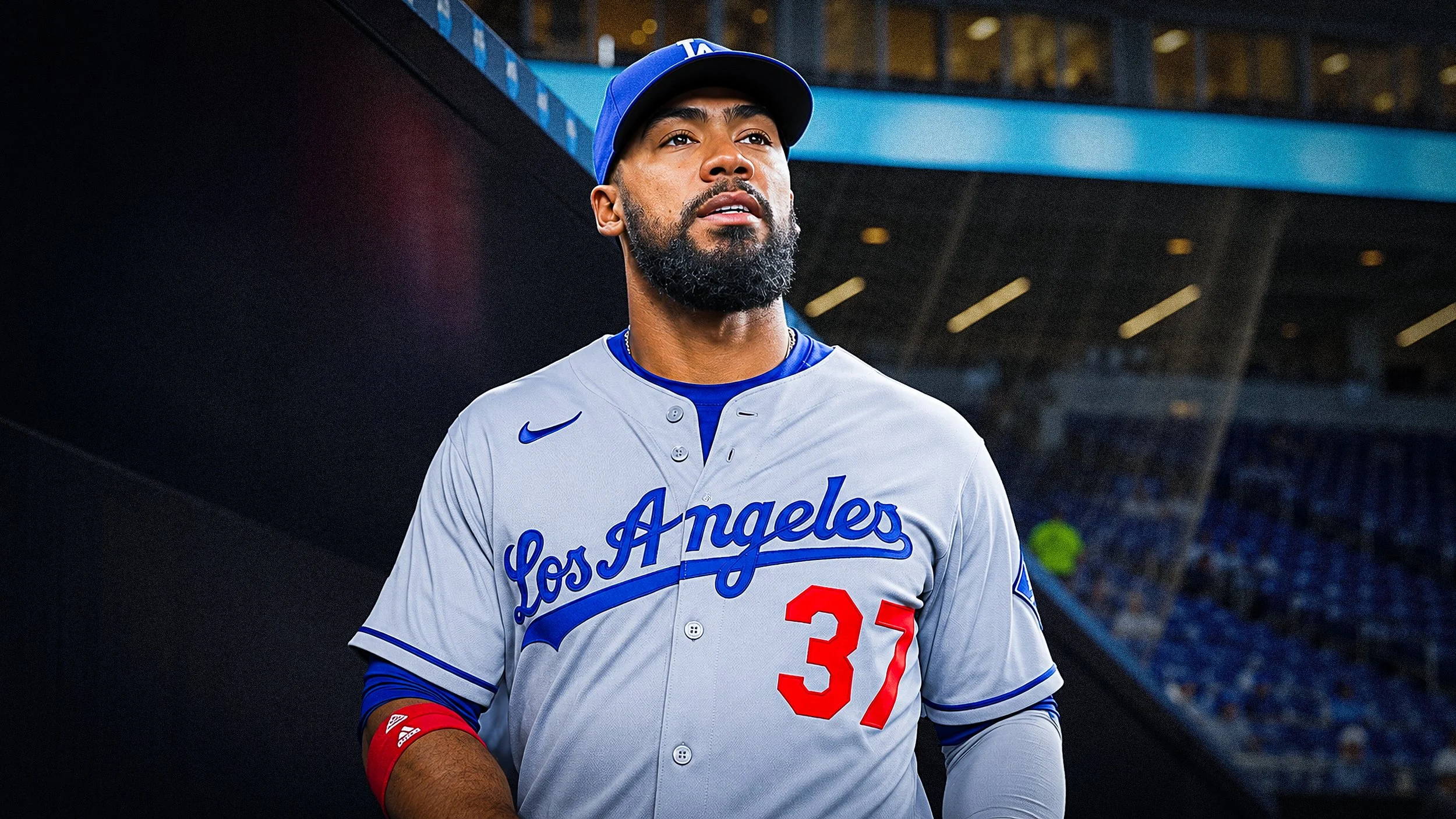
For the first time this offseason, the Dodgers’ position on a possible Teoscar Hernández trade is beginning to take shape.
Los Angeles is expected to listen when other teams call about the veteran outfielder, according to Jack Harris’ reporting from the General Managers Meetings.
That is a meaningful development.
It is not confirmation that the Dodgers have decided to trade Hernández.
Brandon Gomes made clear that Los Angeles does not feel pressured to move him, and there is no reported agreement, imminent deal or confirmed negotiation with another club.
The Dodgers are simply willing to see what the market offers.
That distinction matters because the decision is about more than whether Hernández remains valuable. It is tied directly to how quickly Los Angeles believes Josue De Paula can become its everyday left fielder.
Listening Is Not The Same As Shopping Him
Almost every established player can be discussed under the right circumstances.
For the Dodgers, listening on Hernández makes sense because his situation intersects with several of their larger offseason objectives.
Los Angeles wants to become younger and more athletic. Hernández is entering his age-34 season, his defense has declined and his overall power production fell in 2026.
Trading him would also create the clearest opening for De Paula, one of baseball’s best prospects and a potential building block for the Dodgers’ next core.
But the Dodgers do not need to force a transaction.
Hernández remains under contract, still provides above-average offense and fills a specific role against left-handed pitching that is not easily replaced.
The Dodgers can afford to keep him unless another club offers something that makes the roster better.
Hernández Remained An Above-Average Hitter
Hernández’s overall 2026 production was respectable:
.267 batting average
.334 on-base percentage
.425 slugging percentage
.759 OPS
16 home runs
64 RBIs
110 wRC+
The home-run total represented a noticeable decline from the 25 he hit in 2025 and the 33 he produced during his first season with the Dodgers.
His isolated power also dropped from .207 to .158, showing that the reduction was not solely the product of playing nine fewer games.
However, his overall numbers do not tell the complete story.
Hernández endured a difficult middle portion of the season before responding with a much stronger second half. He batted .291 with an .814 OPS over his final 62 games after the All-Star break, demonstrating that he was still capable of making adjustments and producing against Major League pitching.
Trading him based only on his worst stretch would ignore how well he finished.
His Production Against Lefties Still Matters
Hernández remains one of the Dodgers’ most dependable hitters against left-handed pitching.
He batted approximately .304/.397/.527 against lefties in 2026, with six home runs in 131 plate appearances. baseballsavant.com
That production matters because the Dodgers’ lineup can become heavily left-handed.
Shohei Ohtani, Freddie Freeman, Kyle Tucker and De Paula all hit from the left side. Alex Freeland and Hyeseong Kim are also left-handed options for the infield.
Replacing Hernández with De Paula would make the lineup younger and potentially more dangerous against right-handed pitching.
It could also remove one of its best counters against lefties.
As Blue Dynasty previously examined in our report on why making room for De Paula is more complicated than trading Hernández, clearing a position does not automatically create a balanced lineup.
If the Dodgers trade Hernández, they need another plan for replacing his right-handed production.
De Paula’s Bat Has Forced The Conversation
The Dodgers would probably not be considering their outfield this way if De Paula had not made such a strong first impression.
The 21-year-old jumped directly from Double-A Tulsa and reached base 21 times in his first 42 Major League plate appearances.
He batted .323/.500/.581 with one home run, seven RBIs, 11 walks and only five strikeouts during his September opportunity.
De Paula then drew two more walks in three postseason plate appearances.
The sample was small, but the quality of his at-bats stood out. He controlled the strike zone, did not appear overwhelmed by Major League velocity and showed the calm offensive approach the Dodgers believed would translate.
His performance made a larger 2027 role worth discussing.
It did not resolve the defensive question standing between him and that role.
Dodgers Are Not Moving De Paula To Another Position
The Dodgers are not currently considering moving De Paula away from the outfield, according to Harris.
That means they are not preparing to solve the problem by converting him into a first baseman or trying another position.
Their focus remains helping him become a dependable corner outfielder.
“He is dead set on proving that he’s going to be a really good defender,” Gomes said. “We have full confidence that he’s going to put the work in to really continue to take those steps forward and be the complete player that we all know he can be.” Los Angeles Times
The Dodgers believe De Paula improved defensively from 2025 to 2026, but they still used him almost exclusively at designated hitter after his promotion.
He logged only six defensive innings in left field.
That was possible because Ohtani was on the injured list. With Ohtani expected to return as the regular designated hitter in 2027, De Paula must play defense to receive everyday at-bats.
De Paula Has Not Been Handed Left Field
Keeping De Paula in the outfield does not mean the Dodgers have committed to him as their Opening Day left fielder.
His offseason progress will help determine whether Los Angeles believes he can learn at the Major League level or needs additional defensive development at Triple-A.
The Dodgers have several possible paths:
Trade Hernández and give De Paula an everyday opportunity.
Keep Hernández while gradually expanding De Paula’s role.
Begin De Paula at Triple-A and reassess during the season.
Keep both and use a matchup-based rotation in left field.
Trade Hernández but acquire another right-handed outfielder for protection.
None of those possibilities has been eliminated.
A Hernández trade would create an opening, but it would also remove the veteran safety net if De Paula struggles defensively or experiences the normal offensive adjustments that come with a first full Major League season.
The Dodgers must decide whether they are comfortable accepting those growing pains while attempting to win another championship.
The Defensive Difference Could Be Smaller Than It Appears
Hernández’s defense is one of the strongest arguments for considering a trade.
He finished 2026 with minus-five Defensive Runs Saved and minus-five Outs Above Average across 999 innings in the corner outfield. Yardbarker
The Dodgers would like to improve their athleticism and run prevention, particularly around a veteran infield and a pitching staff built to compete in October.
De Paula has greater long-term upside, but he should not automatically be treated as an immediate defensive upgrade.
His routes, reactions and consistency remain works in progress. MLB Pipeline grades his fielding tool at 40 on the 20-to-80 scouting scale.
The defensive argument for making the change is therefore about projection.
Hernández is unlikely to become significantly better at 34. De Paula is 21, has the physical tools to improve and could develop into at least a playable corner outfielder.
The Dodgers must determine how much short-term uncertainty they are willing to accept for the possibility of long-term growth.
Hernández’s Contract Is Tradable But Not Inexpensive
Hernández is scheduled to receive a $14.5 million salary in 2027, with $8 million deferred.
The Dodgers also hold a $15 million club option for 2028 with a $6.5 million buyout. That leaves $21 million guaranteed before accounting for how the deferred money affects the payment schedule. mlb.com
That contract should not prevent a trade, but it will influence the return.
Teams are unlikely to surrender premium prospects for an aging corner outfielder with declining defensive value and one guaranteed season remaining.
The Dodgers could improve the return by paying part of his remaining contract.
That may be preferable to treating the move as a salary dump. Los Angeles does not need to sacrifice a useful hitter merely to reduce payroll.
As we explored in what would make trading Hernández worthwhile, the return should address another roster need.
A controllable bullpen arm, a younger infielder or a near-Major-League prospect with a clear path could make sense.
A marginal prospect and financial relief would not provide enough baseball value.
Keeping Both Players Would Create A Playing-Time Problem
Keeping Hernández and De Paula sounds like the safest option because it preserves depth.
The daily roster math would be difficult.
Kyle Tucker is expected to play right field, Andy Pages has established himself in center and Ohtani occupies designated hitter.
That leaves one position for Hernández and De Paula.
The Dodgers could use Hernández against left-handed pitchers and De Paula against righties. That would create a logical platoon on paper, but it might not provide De Paula with the consistent playing time needed to develop.
Hernández would also have to accept a reduced role after operating as a regular throughout his Dodgers tenure.
Injuries usually create additional at-bats, but building the Opening Day roster around anticipated injuries would not provide either player with clarity.
The Dodgers eventually must choose between prioritizing Hernández’s remaining veteran production and creating room for De Paula’s development.
Trading Teo Could Create Another Offensive Problem
The Dodgers hit 40 fewer home runs in 2026 than they did the previous season.
Hernández contributed to that decline, falling from 25 homers to 16. His power is no longer at its 2024 level, but removing him does not automatically improve the lineup.
De Paula’s upside is substantial, yet the Dodgers cannot responsibly project his 1.081 OPS from 42 plate appearances across a full season.
Young hitters adjust to Major League pitching. Pitchers identify weaknesses, change how they attack and force prospects to respond.
The Dodgers also need more right-handed production—not less.
If Hernández is traded, the front office should use another position to restore some of that balance. A right-handed infielder, fourth outfielder or platoon bat could allow De Paula to receive regular opportunities without leaving the Dodgers exposed against lefties.
The Dodgers Should Listen Without Forcing A Deal
The newest reporting confirms what the roster already suggested.
Hernández is not untouchable.
His age, defense, contract and De Paula’s emergence give the Dodgers legitimate reasons to discuss a trade.
But the organization’s position also appears appropriately measured.
Los Angeles does not need to move him. It can wait for the market to develop and determine whether another club values his bat enough to surrender something useful.
If the return fills another need and the Dodgers believe De Paula’s defense is ready, a trade could accelerate the roster’s transition toward a younger core.
If the offers amount to little more than salary relief, keeping Hernández preserves a proven bat against left-handed pitching and protects the Dodgers from placing too much immediate responsibility on De Paula.
The decision should not be framed as choosing between a declining veteran and a future star.
It is about determining when De Paula is ready, what Hernández still provides and whether another team offers enough to make the transition worthwhile.
The Dodgers should listen. They should not trade Teoscar Hernández simply because other teams call.
What would you need in return to support moving Teo and giving De Paula the everyday opportunity in left field?