
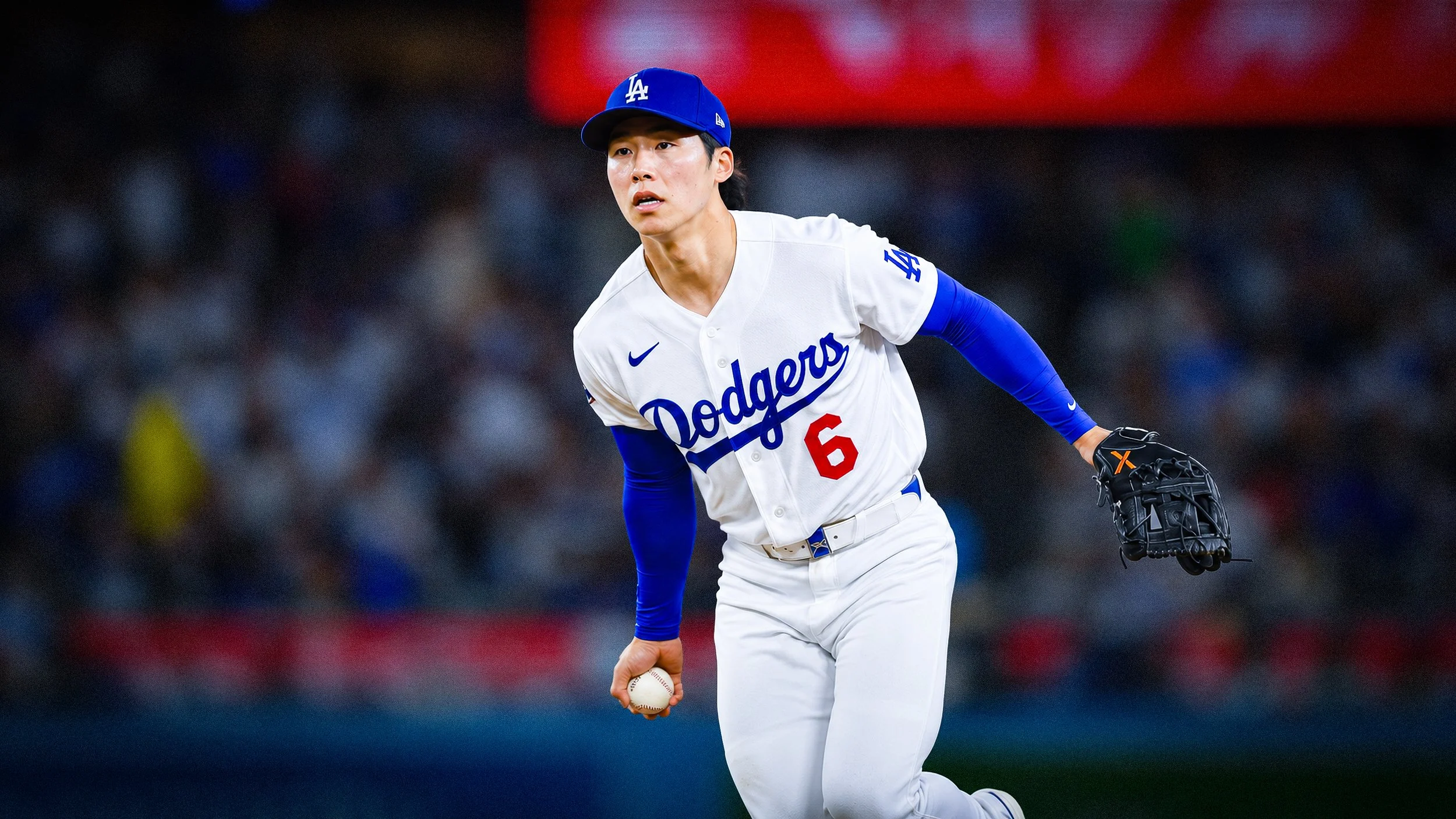
The Dodgers have identified second base as one of the clearest areas where their offense can improve.
Whether they address it through a trade, free agency or an internal option could depend partly on what Hyeseong Kim accomplishes this offseason.
Brandon Gomes acknowledged that Kim did not produce the offensive season he expected in 2026, but said the 27-year-old began working on adjustments late in the year and presented the Dodgers with a plan for continuing that work during the offseason.
“Comet did not have the year that he was expecting offensively, but he has so many skills that fit us well,” Gomes said. “Hopefully he’ll take a step forward on the swing mechanics and get him into a really good place offensively.”
The Dodgers still believe in Kim’s speed, defensive flexibility and overall athleticism.
The question is whether his bat can become productive enough for those skills to matter regularly.
Second Base Was The Dodgers’ Weakest Offensive Position
The Dodgers received a combined .676 OPS from their second basemen in 2026, their lowest mark at any defensive position.
Los Angeles still ranked fourth in MLB with 801 runs, but its lineup experienced extended periods of inconsistency and became increasingly dependent upon its established veteran hitters.
Adding more production at second base would not solve every offensive problem. It could, however, remove one of the lineup’s easier outs and create greater flexibility elsewhere.
Tommy Edman currently projects as the most established second-base option. He finished 2026 with a .714 OPS across 84 games, but much of his value comes from being able to move between the infield and outfield.
Using Edman as the everyday second baseman would address the position defensively, but it would also limit the Dodgers’ ability to deploy him wherever injuries or matchups create the greatest need.
Alex Freeland and Kim are the other immediate internal possibilities. Neither has established himself as a dependable everyday Major League hitter.
MLB.com’s Sonja Chen identified upgrading second base as one way the Dodgers could improve their offense, noting that Los Angeles may explore the trade and free-agent markets while continuing to evaluate its internal options. mlb.com
Kim changing that calculation would give the Dodgers more freedom to use their offseason resources elsewhere.
Kim’s 2026 Season Started Well Before Falling Apart
Kim opened the season with an encouraging stretch.
He hit .314 with an .800 OPS through his first 26 games and initially appeared capable of holding the left-handed side of a second-base platoon.
His production then declined sharply.
Kim hit .174 with a .424 OPS over his next 17 games before the Dodgers optioned him to Triple-A. Los Angeles wanted him to play regularly and restore the setup and swing mechanics that had helped him early in the season.
He finished his Major League time batting:
.259 average
.323 on-base percentage
.328 slugging percentage
.651 OPS
One home run
Five stolen bases
31 strikeouts in 131 plate appearances
Kim performed considerably better against right-handed pitching, batting .284/.348/.363 across 116 plate appearances. His opportunities against left-handers were extremely limited, but he collected only one hit in 14 at-bats.
That split made him usable in favorable matchups.
It did not establish him as an everyday second baseman. mlb.com
Triple-A Did Not Produce The Expected Reset
The decision to option Kim was intended to give him consistent at-bats and time to correct the mechanical drift the Dodgers had identified.
The results remained underwhelming.
Kim played 85 games for Oklahoma City and hit .262/.330/.345 with three home runs. His .674 OPS was only slightly better than the .651 mark he produced in the majors.
That matters when evaluating his 2027 role.
If Kim had dominated Triple-A following his demotion, the Dodgers could point to his Major League struggles as a small sample or adjustment period. Instead, the lack of power and inconsistent offensive production followed him to Oklahoma City.
Across Triple-A and the majors, Kim recorded only four home runs in 128 games.
The offseason work therefore cannot be limited to returning him to his early-2026 form. The Dodgers need to help him develop a more sustainable swing capable of producing against Major League velocity and generating enough damage to keep pitchers honest. Los Angeles Times
Kim Must Begin Producing More Authoritative Contact
Kim does not need to become a 25-home run hitter.
That has never been his profile.
He does, however, need to hit the ball with enough authority to prevent opposing pitchers from attacking him inside the strike zone without consequence.
Kim’s 2026 Statcast numbers illustrate the problem:
85.8 mph average exit velocity
25.3 percent hard-hit rate
3.4 percent barrel rate
.341 expected slugging percentage
The Dodgers, as a team, produced an 89.2 mph average exit velocity and a 39.6 percent hard-hit rate.
Kim was well below both marks.
His .069 isolated-power figure was also among the clearest indications that his offensive value depended almost entirely on singles, walks and speed. Isolated power subtracts batting average from slugging percentage, providing a simple measurement of extra-base impact.
For comparison, Kim posted a .106 ISO during his first Major League season in 2025. That was already modest, but it still represented considerably more extra-base production than he provided in 2026.
The objective of his swing changes should not be to turn him into a different type of hitter. It should be to help him drive pitches he can handle rather than merely putting them in play.
A line-drive hitter with Kim’s speed can produce value without major home-run totals.
A hitter with limited power, declining contact and a .323 on-base percentage has a much narrower path.
The Strikeout Rate Also Needs Attention
Kim’s speed and bat-to-ball reputation were two of the qualities that made him interesting when the Dodgers signed him out of South Korea.
Those skills have not translated consistently.
Kim struck out in 23.7 percent of his Major League plate appearances in 2026. That was an improvement from his 30.6 percent rate during his rookie season, but it remained high for a hitter who produced only one home run.
A power hitter can survive an elevated strikeout rate because the damage compensates for the empty plate appearances.
Kim does not currently provide that tradeoff.
For his offensive profile to work, he needs to put more balls in play, produce line drives and reach base frequently enough to use his speed.
That means the Dodgers should evaluate more than his batting average during Spring Training.
They need to watch:
Whether his setup remains consistent
How he handles elevated fastballs
Whether his swing produces more line drives
Whether his strikeout rate continues declining
Whether his contact carries into the gaps
How frequently he reaches base against right-handed pitching
A short hot streak built on ground-ball singles would not answer the larger questions.
Better swing decisions and more authoritative contact would.
His Speed Can Only Matter If He Reaches Base
Kim’s athleticism remains one of the strongest arguments for giving him another opportunity.
He stole 211 bases during his eight seasons in the KBO and recorded 18 steals during his first two years with the Dodgers. He was successful on 13 of 14 attempts as a Major League rookie.
That ability adds a dimension the Dodgers’ veteran-heavy lineup otherwise lacks.
Kim can pressure defenses, take an extra base and provide value late in games as a runner. He also gives Los Angeles coverage at multiple defensive positions.
But speed cannot compensate for insufficient offensive production in an everyday role.
Kim recorded only five Major League steals in 2026 because he was not on the roster long enough—or reaching base frequently enough—to become a consistent factor.
Improving his swing would not only raise his batting numbers. It would unlock the part of his game that makes him different from most of the Dodgers’ other infield options.
Second Base May Be His Best Defensive Fit
Kim appeared at second base, shortstop and left field during the 2026 season.
He started 24 games at shortstop but committed four errors across 202 innings. At second base, he handled 108 innings without an error.
Fielding percentage alone does not determine defensive ability, particularly in limited samples. But Kim’s experience, quickness and range make second base a more natural long-term fit than asking him to handle shortstop regularly.
Over his first two Major League seasons, Kim has played 61 games at second base, 38 at shortstop and 17 in center field.
That versatility has value.
For Kim to change the Dodgers’ plans, though, he must become more than someone capable of filling several positions. He needs to give Los Angeles confidence that putting him at second base improves the lineup rather than merely covering the position.
The Dodgers Do Not Need To Decide Immediately
Kim is entering the final guaranteed season of the three-year, $12.5 million contract he signed before the 2025 season.
The Dodgers hold club options covering 2028 and 2029, creating additional incentive to determine whether he can become part of their longer-term plans. mlb.com
His affordable contract means Los Angeles does not need to move him simply because he struggled in 2026.
It also means the Dodgers should not enter the offseason depending upon a breakthrough that has not happened.
They can allow Kim to continue his swing work while simultaneously exploring the market for another infielder. If an obvious upgrade becomes available, they should not pass because Kim might improve.
If no compelling acquisition materializes, Kim can compete with Freeland and Edman during Spring Training.
That competition could determine whether the Dodgers use:
Edman as the primary second baseman
A Kim-Freeland platoon
Kim as a utility player and pinch-running option
An outside acquisition as the everyday answer
Charles Davalan may eventually enter that conversation, but his Arizona Fall League work at second base remains developmental. The Dodgers should not construct their 2027 roster under the assumption that he will be ready immediately.
What Would Kim Need To Show?
Kim can change the Dodgers’ plans, but a simple mechanical adjustment will not be enough.
He needs to show that the adjustment creates measurable improvement.
The Dodgers should feel better about their internal options if Kim demonstrates:
More consistent contact against Major League velocity
Kim’s strikeout rate improved in 2026, but it remained too high for a hitter with limited power.
Greater extra-base impact
He does not need to become a slugger, but a .328 slugging percentage will not support an everyday role.
A dependable offensive floor against right-handed pitching
His .711 OPS against right-handers provides a possible foundation. He needs to sustain or improve it over a larger sample.
Enough on-base ability to activate his speed
Kim becomes significantly more valuable when he can regularly pressure opposing defenses.
Stable defense at second base
His versatility is helpful, but becoming trustworthy at one primary position would make his roster fit clearer.
If those changes appear in Spring Training, Kim could make the Dodgers reconsider whether an outside addition is necessary.
If they do not, Los Angeles should avoid forcing an internal answer at a position that already provided the team’s weakest offensive production.
Kim Still Has An Opportunity
Kim’s first two Major League seasons have not matched the expectations created by his career in South Korea.
He owns a respectable .271 batting average across 301 Major League plate appearances, but his .318 on-base percentage, .361 slugging percentage and four home runs reveal how little margin exists in his current offensive profile.
He has not been a complete failure.
He also has not given the Dodgers enough evidence to make him their everyday second baseman.
The offseason swing work gives him another opportunity to change that.
Gomes’ comments show that Los Angeles has not given up on Kim. The Dodgers still see skills that can help them, and they believe there are mechanical changes capable of putting him in a better offensive position.
Now Kim must demonstrate that those changes translate into more than another brief hot start.
If Kim can produce consistent contact, reach base and create more extra-base damage, the Dodgers may already have part of their second-base solution. If not, this remains one of the clearest positions for Los Angeles to upgrade.
Would you give Kim a real opportunity to win the second-base job, or should the Dodgers acquire a more established hitter?