
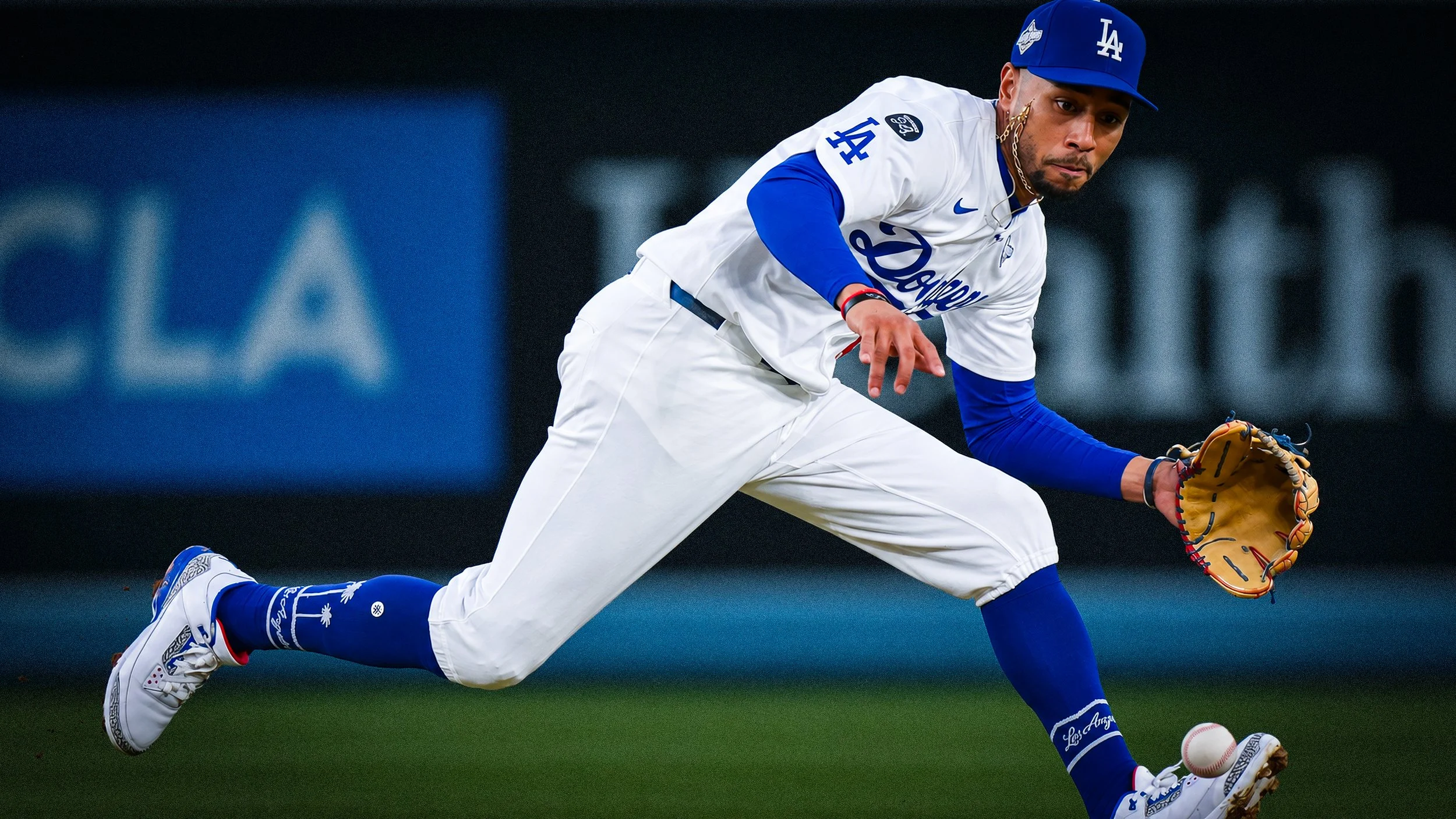
The Dodgers are not planning another position change for Mookie Betts.
When Brandon Gomes was asked directly whether Betts would remain at shortstop in 2027, his answer was immediate.
“Absolutely.”
Gomes praised the work Betts has put into the position and rejected the suggestion that playing shortstop meaningfully damaged his offensive production.
“I think watching what Mook does every day at short and pouring into the defensive side is wildly impressive,” Gomes said. “I don’t think this is something that has meaningfully affected his offense.”
That does not completely settle the debate over whether the physical and mental demands of shortstop have influenced Betts at the plate.
It does settle the Dodgers’ current plan.
They expect Betts to remain their shortstop in 2027.
Betts Has Earned The Opportunity Defensively
The decision is supported by more than Betts’ reputation or willingness to take on a difficult position.
He has become a legitimate defensive asset at shortstop.
Betts appeared in 122 games at the position during the 2026 regular season. Statcast credited him with nine Outs Above Average and a plus-seven Fielding Run Value, placing him in the 94th percentile among Major League defenders. Los Angeles Dodgers
The final SABR Defensive Index also rated Betts positively at 4.2 runs above the average defender at his position. Society for American Baseball Research
That performance followed a strong first full season at shortstop in 2025, when Betts produced 17 Defensive Runs Saved and six Outs Above Average.
One strong defensive season might have been dismissed as a successful experiment.
Two consecutive seasons of above-average performance make it much harder to argue that Betts is merely surviving at shortstop.
He has developed into a dependable defender at one of the most demanding positions on the field.
The Offensive Question Is More Complicated
Betts did not produce at his customary level for much of 2026.
He finished the regular season batting .257/.326/.454 with 23 home runs, 69 RBIs and a .780 OPS. His 114 wRC+ meant he remained approximately 14 percent better than the average Major League hitter after adjusting for league and park conditions. MiLB.com
Those numbers would represent a productive season for most shortstops.
For Betts, they continued a noticeable decline from the offensive standard he established throughout his career.
Betts owns a career .288/.366/.508 line with an .874 OPS. He produced a .987 OPS as recently as 2023 and remained one of the game’s most dangerous hitters before his production fell to a .732 OPS in 2025.
The concern is therefore understandable.
Betts is entering his age-34 season. He has now completed two years with offensive production well below his career norms while also taking on the daily demands of shortstop.
Gomes does not believe the two developments are meaningfully connected.
The performance data cannot prove that conclusion, but Betts’ finish provides evidence that he was still capable of producing elite offense without leaving the position.
September Complicates The Position Argument
Betts was one of baseball’s best hitters during the final month of the regular season.
He batted .337/.438/.674 with a 1.112 OPS in September, producing seven home runs and 23 RBIs over his final 30 games. His 202 wRC+ ranked among the best marks in baseball during the month. www.mlb.com
That surge occurred while Betts continued playing shortstop.
It does not prove the position had no effect on his earlier struggles. Offensive performance can be influenced by health, age, swing mechanics, timing and several other factors that are difficult to isolate.
But his September production weakens the argument that Betts simply cannot remain an impact hitter while playing shortstop.
If the position were preventing him from producing offensively, it would be difficult to explain how he became a top-10 Major League hitter over the final six weeks without changing positions.
The larger question is whether that finish represented a sustainable adjustment or another brief surge inside a two-year decline.
Betts hit only .207/.343/.207 without an extra-base hit during the postseason, so his September improvement did not fully carry into October.
That is why the Dodgers should not dismiss the offensive concern entirely.
They can believe in Betts as their shortstop while still examining what he needs to regain more of his previous offensive impact.
The Decision Removes One Potential Solution At Second Base
Confirming Betts at shortstop also clarifies another part of the Dodgers’ offseason.
They are not planning to move him to second base to create room for another shortstop.
That means Los Angeles must find its second-base production from Tommy Edman, Hyeseong Kim, Alex Freeland or an outside acquisition.
The Dodgers received a combined .676 OPS from their second basemen in 2026, their lowest production at any defensive position. mlb.com
None of the primary internal options has secured the everyday job:
Tommy Edman hit .247/.329/.385 with a .714 OPS across 84 games. His defensive versatility may make him more valuable moving between positions than remaining at second base every day. Los Angeles Dodgers
Hyeseong Kim hit .259/.323/.328 with one home run and a .651 OPS in 43 Major League games. He is working on offseason swing changes after also producing only a .674 OPS in Triple-A.
Alex Freeland hit .234/.327/.325 with four home runs and a .652 OPS across 89 Major League games. He showed useful on-base ability but did not provide enough impact to establish himself as the answer. Los Angeles Dodgers
Betts remaining at shortstop does not force the Dodgers to acquire another second baseman.
It does make that position one of the clearest places for the club to improve its lineup.
As we examined in our breakdown of whether Hyeseong Kim can change the Dodgers’ plans at second base, Los Angeles can allow its internal candidates to compete while continuing to explore the trade and free-agent markets.
Betts’ Defense Gives The Dodgers Valuable Stability
There is a reasonable argument for eventually moving Betts to second base as he ages.
That argument is about the future.
The available evidence does not show that the Dodgers need to make the move now.
Betts remains an above-average defensive shortstop. His overall offense remained above league average despite a prolonged slump. His September surge demonstrated that high-level offensive production is still possible while he handles the position.
Moving him would create another hole at shortstop without guaranteeing that his offensive production would improve.
The Dodgers already have uncertainty at second base, left field and several bench positions. Keeping Betts at shortstop provides stability at a premium position while allowing them to focus elsewhere.
It also removes the need to pursue a shortstop simply for the purpose of shifting Betts.
If an extraordinary young player became available, Los Angeles could always reconsider. Gomes’ answer describes the Dodgers’ plan—not an irreversible commitment that would prevent them from reacting to an unexpected opportunity.
The Dodgers Are Betting On A Complete Betts Rebound
Gomes’ confidence goes beyond Betts’ defense.
He believes the Dodgers will receive stronger offensive production from him next season.
“We’ve seen that guy that is in there,” Gomes said. “He’s going to go out and be who he is and give us great at-bats and produce really high-quality offense for us again next year.”
That is the bet Los Angeles is making.
The defensive portion is already supported by two seasons of performance data.
The offensive portion remains less certain.
Betts does not need to recreate his 2018 MVP season for the decision to work. An above-average hitter providing premium defense at shortstop remains extremely valuable.
But if the Dodgers want their veteran-heavy lineup to avoid another late-season decline, they need more than the .780 OPS Betts produced overall—and more than the .550 OPS he managed during the postseason.
They need the hitter who reappeared in September to remain present for a much larger portion of 2027.
Gomes believes Betts can do that without changing positions.
The Dodgers’ offseason plans will proceed accordingly.
Do you agree with keeping Mookie Betts at shortstop, or would you rather move him to second base and pursue a younger shortstop?