
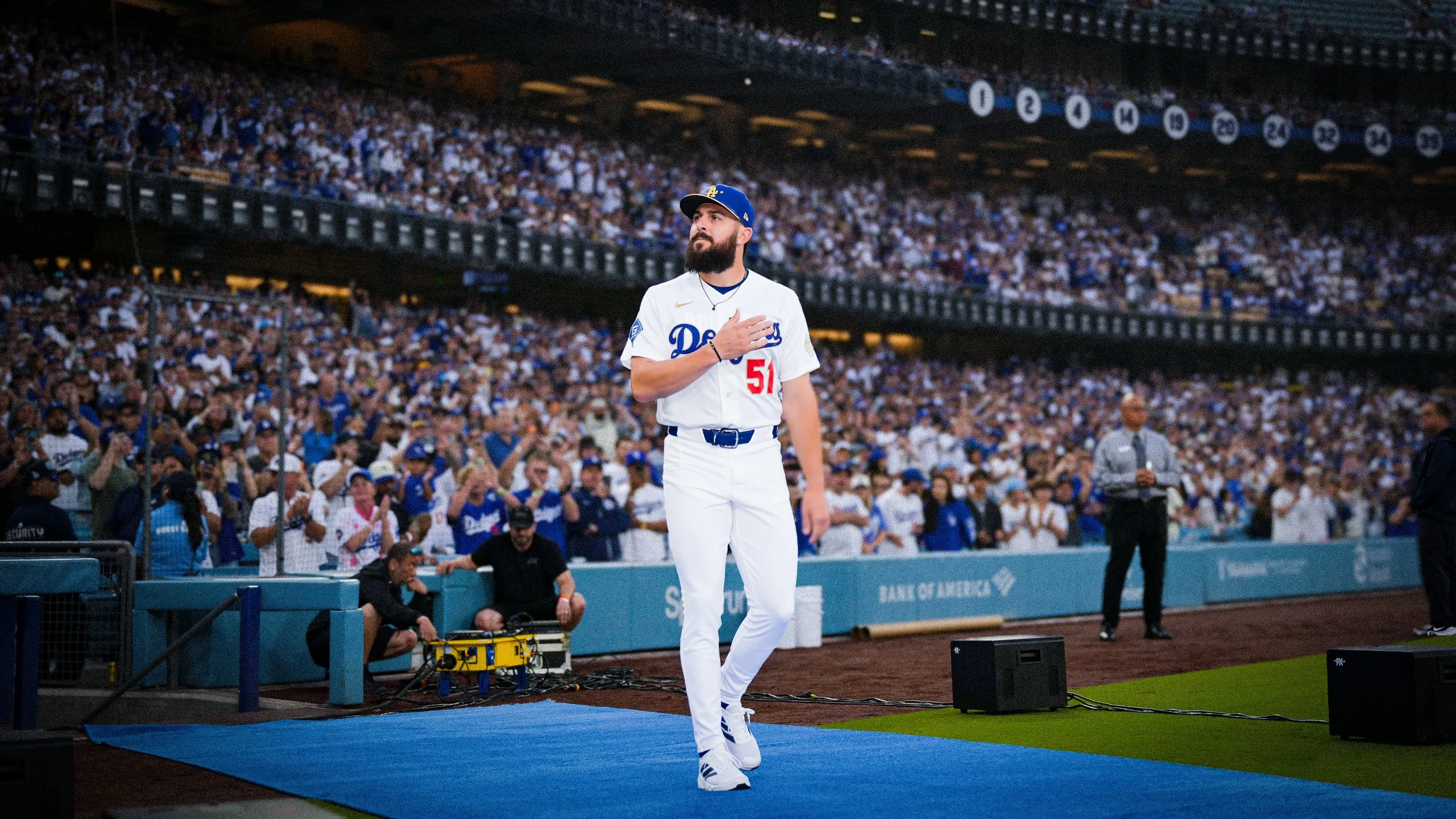
Bringing Alex Vesia back appeared to be one of the Dodgers’ most logical offseason moves.
It may not be one of their easiest.
The Mets have expressed interest in Vesia, and Will Sammon reports that more than half the league has checked in on the free-agent left-hander.
That level of interest could turn Vesia’s market into a competition over both money and years.
Jack Harris reports that Vesia could be positioned to receive three-year offers. That is a projection of where his market may be heading—not confirmation that he already has a three-year proposal in hand.
Still, the Dodgers now have a clearer idea of what retaining one of their most reliable relievers may require.
Vesia Has Built More Value Than A Typical Left-Handed Specialist
The interest in Vesia is not surprising when looking beyond his handedness.
Vesia led the Dodgers with 72 appearances in 2026, recording a 2.64 ERA, 1.07 WHIP and 74 strikeouts across 58 innings. Opponents hit only .147 against him.
He was not effective only against left-handed hitters, either.
Lefties batted .138 with a .471 OPS against Vesia in 2026. Right-handed hitters managed a .155 average and .535 OPS.
That ability to retire hitters from both sides makes Vesia more valuable under the three-batter minimum. He does not need to be removed simply because a right-handed hitter comes to the plate.
His broader track record also gives interested teams more confidence than they would have in a reliever coming off one strong season.
Over the past three years, Vesia appeared in 207 games and produced a 2.45 ERA with a 32.7 percent strikeout rate. Among pitchers with at least 120 innings during that period, he ranked near the top of the league in ERA, expected ERA and strikeout percentage.
He owns a 2.66 ERA across six seasons with the Dodgers and has repeatedly handled postseason and high-leverage situations.
Teams are not evaluating him as a matchup-only left-hander.
They are evaluating him as a legitimate setup reliever.
The Market Could Push The Dodgers Beyond Their Comfort Zone
The Dodgers have the financial ability to retain Vesia.
The more difficult question is whether they want to commit multiple years and a significant annual salary to another reliever.
Public contract projections have already placed Vesia around two years and $26 million, while another estimate put his average annual value above $14 million. Reports that three-year offers could develop suggest the competition may extend beyond the price alone.
A three-year contract would carry Vesia through his age-33 season.
There are reasons to believe he can remain effective. His unusual release, fastball movement and ability to generate swings and misses have allowed him to succeed without overwhelming velocity.
There are also risks.
Vesia’s walk rate climbed to 13.5 percent in 2026, and his average fastball velocity has declined from 94.4 mph in 2023 to approximately 92.1 mph. Neither issue prevented him from producing another strong season, but both matter when evaluating a multiyear commitment to a reliever.
Reliever performance can change quickly. The Dodgers generally try to avoid paying exclusively for past production when they believe a bullpen role can be filled through development, trades or shorter free-agent commitments.
Vesia’s durability and consistency may persuade them to make an exception.
Losing Vesia Would Create A Specific Bullpen Need
The Dodgers would not be left without left-handed relief if Vesia signs elsewhere.
Tanner Scott and Jack Dreyer remain capable options, and both can miss bats. But removing Vesia would leave Los Angeles with one fewer experienced reliever who can handle either side of the plate in the seventh or eighth inning.
That distinction matters.
Scott has experience closing games, while Dreyer has developed into a useful Major League arm. Neither makes Vesia redundant. A deep postseason bullpen needs multiple pitchers capable of protecting a lead against the strongest portion of an opposing lineup.
Vesia’s value also extends beyond a single matchup.
He can enter against a left-handed hitter and remain in the game against the right-handers behind him. That flexibility becomes especially important during October, when opposing teams construct their benches specifically to counter bullpen changes.
Allowing Vesia to leave would not necessarily be a mistake.
Failing to replace his role would be.
Tim Hill Would Offer A Different Type Of Left-Handed Relief
The Dodgers have also been connected to free-agent left-hander Tim Hill, joining the Yankees, Mets, Guardians and Giants among the interested teams.
Hill could help, but he should not be viewed as a direct replacement for Vesia.
Vesia generates strikeouts with a rising fastball profile and can handle hitters from both sides. Hill relies more heavily on contact management and ground balls. He remained effective against left-handed hitters in 2026, but right-handers recorded a .909 OPS against him.
That makes Hill more of a specialized matchup option.
Vesia is the more complete late-inning reliever.
The Dodgers could sign Hill and still need another arm capable of consistently recording important outs against right-handed hitters. They could also retain Vesia and add Hill, giving Dave Roberts two dramatically different left-handed options.
Much would depend on price, roster construction and how the Dodgers evaluate their younger relievers.
The Dodgers Must Decide How Much Continuity Is Worth
Vesia has become one of the bullpen’s most recognizable and dependable pitchers since arriving from Miami before the 2021 season.
He understands how the Dodgers prepare pitchers. He has performed under postseason pressure, handled different bullpen roles and remained available more consistently than several other Los Angeles relievers.
That familiarity has real value.
But more than half the league reportedly recognizing the same value means the Dodgers may not receive any discount for it.
Our take: Los Angeles should make a serious effort to retain Vesia, but not simply because he is familiar.
His recent production supports a multiyear commitment. He misses bats, handles hitters from both sides and has shown the durability necessary to appear 65 or more times in three consecutive seasons.
The question is where the bidding stops making sense.
If another team guarantees a third year at an aggressive salary, the Dodgers must decide whether Vesia’s dependability is worth stretching their preferred contract structure—or whether they can replace his innings through a combination of Scott, Dreyer, a free-agent addition and younger arms.
The worst outcome would be allowing Vesia to leave without a clear plan for replacing what he actually does.
How far should the Dodgers go to keep Vesia: two years, three years or whatever the market requires?