
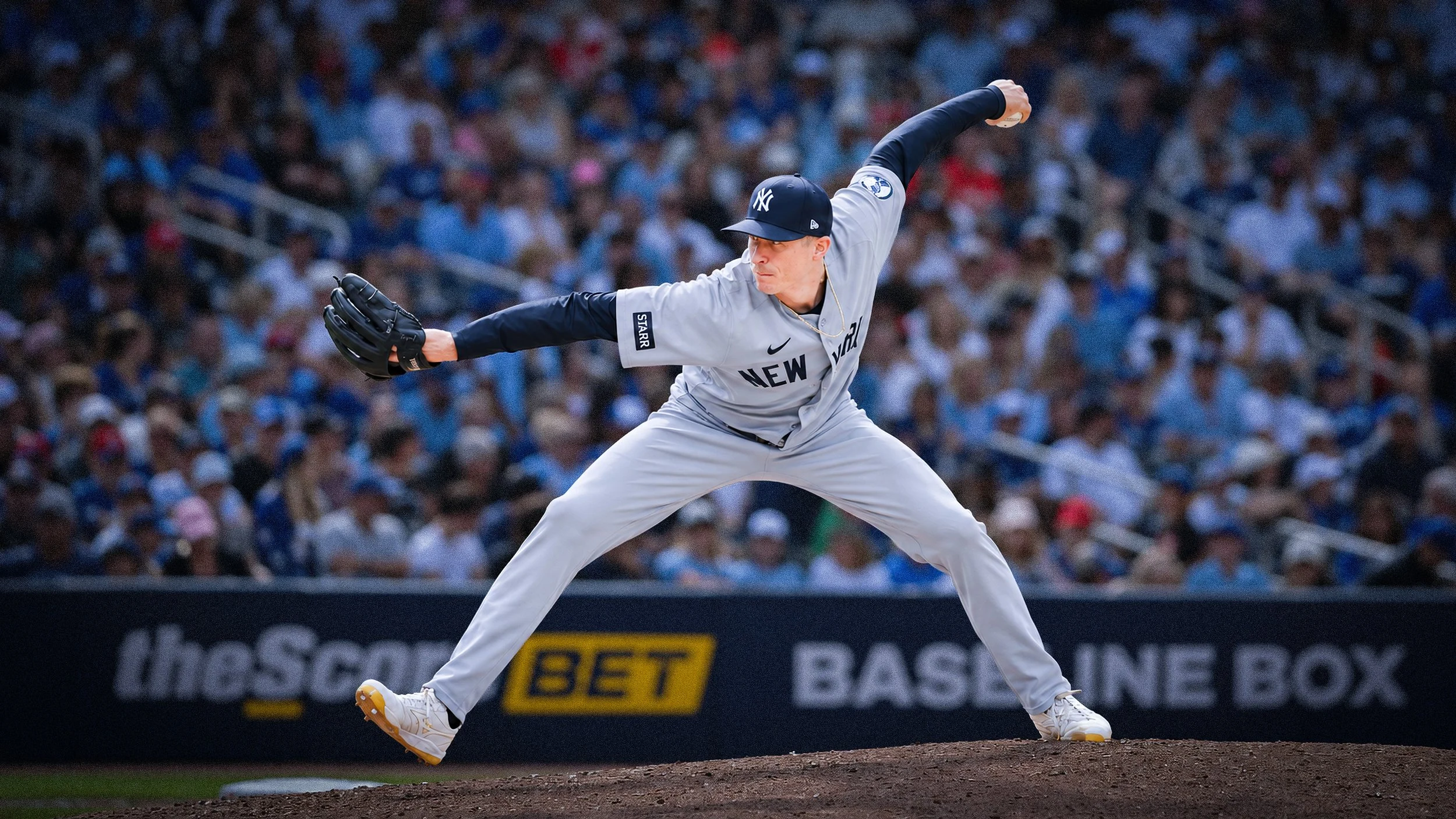
The Dodgers are reportedly exploring another left-handed option for their bullpen.
Jon Heyman reports that Los Angeles is among the teams “in the mix” for veteran reliever Tim Hill. The Guardians, Mets and Giants have also expressed interest, while the Yankees remain interested in bringing him back.
There is no reported agreement, offer or indication that Hill is close to choosing a team.
The Dodgers’ interest makes sense as they evaluate a bullpen with Alex Vesia, Evan Phillips, Blake Treinen, Brusdar Graterol, Kris Bubic and Eric Lauer all entering free agency.
Hill would not replace everything those pitchers provided.
He would give the Dodgers a specific weapon they currently do not have in abundance: a low-slot left-hander who generates ground balls at one of the highest rates in baseball.
Hill Is A Very Different Type Of Reliever
Hill does not overpower hitters.
He rarely reaches 90 mph, does not generate many strikeouts and relies heavily on contact. His value comes from making that contact occur on the ground.
Hill threw his sinker approximately 82 percent of the time in 2026, averaging around 88 mph. He complemented it with a slider and occasional four-seam fastball. baseballsavant.com
That approach produced a 66.3 percent ground-ball rate, compared with a Major League average of approximately 44 percent. baseballsavant.com
Hill has now generated a ground-ball rate above 60 percent in six of his nine Major League seasons.
That creates value in situations when Los Angeles needs a double play, wants to keep a runner from scoring from third or needs an alternative to the high-velocity relievers that populate most modern bullpens.
Hill does not miss bats like Vesia.
He attempts to avoid dangerous contact by keeping the ball out of the air.
His 2026 Results Were Uneven
Hill’s overall 2026 numbers require an honest evaluation.
He appeared in 67 games for the Yankees, finishing 5-2 with two saves, a 4.60 ERA and a 1.14 WHIP across 58⅔ innings. He allowed 54 hits, walked 13 and struck out only 25. MLB.com
His strikeout rate fell to approximately 10.4 percent, among the lowest marks for any Major League reliever.
The lack of swing-and-miss ability creates very little margin for error. When Hill’s sinker stays down, hitters pound it into the ground. When it remains elevated or loses movement, he does not have an overpowering secondary pitch capable of escaping trouble.
Hill allowed 12 home runs in 2026 after surrendering eight in 2025 and only two in 2024.
His 5.93 FIP was also considerably worse than his 4.60 ERA, suggesting his results could have been even more damaging without the defense behind him.
The Yankees ultimately left him off their American League Division Series roster.
That does not mean Hill can no longer help a contender.
It means the Dodgers would need to define his role carefully.
Hill Remained Effective Against Left-Handed Hitters
The strongest argument for signing Hill is his performance against left-handed batters.
Lefties hit only .213/.265/.346 with a .611 OPS against him in 2026. Hill walked six and struck out 16 across 137 left-on-left matchups. baseballsavant.com
His results against right-handed hitters were substantially worse.
Righties batted .293/.365/.543 with a .908 OPS against him. They hit seven home runs and recorded nine extra-base hits in 104 plate appearances. si.com
That split shows both his potential value and his limitation.
Hill can still neutralize left-handed hitters and generate a ground ball when needed. Asking him to consistently work through pockets of dangerous right-handed bats would create far more risk.
Because pitchers must face at least three batters unless an inning ends, the Dodgers could not use Hill as a traditional one-batter specialist. They would need to identify lineup sections where his ground-ball profile provides value without exposing him to too many powerful right-handed hitters.
Hill Has Been Durable Throughout His Career
Hill’s age will be part of the evaluation.
He turns 37 in February, making him considerably older than Vesia, Jack Dreyer or most of the Dodgers’ internal bullpen candidates.
He has nevertheless remained available.
Hill has made at least 60 appearances in five Major League seasons and has appeared in 519 career games. He owns a 3.94 ERA across 448 innings. MLB.com
His recent workload has been particularly consistent:
2024: 62 appearances, 3.36 ERA
2025: 70 appearances, 3.09 ERA
2026: 67 appearances, 4.60 ERA
The 2026 regression should prevent the Dodgers from treating Hill as a guaranteed late-inning solution.
His durability could still be valuable for a team that has repeatedly needed more relief innings than expected.
Hill Would Not Be A Direct Replacement For Vesia
The Dodgers must avoid treating all left-handed relievers as interchangeable.
Vesia recorded a 2.64 ERA, 1.07 WHIP and 74 strikeouts across 58 innings in 2026. He appeared in 72 games and handled higher-leverage situations throughout the season. MLB.com
Hill pitched nearly the same number of innings but recorded only 25 strikeouts.
Vesia can enter with runners on base and generate a strikeout without allowing the ball to be put in play. Hill depends upon his defense converting ground balls into outs.
The difference matters during October, when one ball finding a gap can change an entire series.
Signing Hill would therefore make the most sense as a complementary move rather than the Dodgers’ sole response to potentially losing Vesia.
Los Angeles could still attempt to re-sign Vesia or pursue another swing-and-miss reliever while using Hill in a more specialized middle-inning role.
Dodgers Already Have Left-Handed Bullpen Options
The Dodgers are not without left-handed relievers.
Tanner Scott remains under contract and reestablished himself as an important late-inning option in 2026. Jack Dreyer also provides a younger internal possibility after throwing 64⅔ innings with a 3.20 ERA.
Ronan Kopp remains on the 40-man roster, while Justin Wrobleski could factor into either the rotation or bullpen depending upon how the rest of the pitching staff is constructed.
Adding Hill would give Los Angeles a different look from those pitchers.
Scott and Dreyer can miss bats. Hill would be used to attack the bottom of the strike zone, generate weak contact and potentially escape innings with one pitch.
That type of contrast can make a bullpen more difficult to prepare for, particularly when Hill follows a harder-throwing right-hander.
The Dodgers Have Several Bullpen Decisions Ahead
Los Angeles entered the offseason with a group of relievers whose roles remain unsettled.
As we outlined when nine Dodgers officially entered free agency, Vesia, Phillips, Treinen, Graterol, Bubic and Lauer are all available to other teams.
Phillips, Treinen and Graterol also carry significant recent injury histories.
The Dodgers still have Edwin Díaz, Scott, Edgardo Henriquez, Brock Stewart, Dreyer, Will Klein and several younger arms under team control. The question is how much proven depth they want behind that group.
Hill could provide regular-season innings without requiring the kind of financial commitment attached to a top free-agent reliever.
He would not solve every bullpen need.
Los Angeles would still need reliable right-handed options, swing-and-miss ability and enough depth to withstand injuries.
The Price And Role Would Determine The Fit
Hill makes sense for the Dodgers if the contract reflects what he currently is.
He is an experienced, durable ground-ball specialist who can still retire left-handed hitters.
He is not a late-inning strikeout weapon, and his 2026 results against right-handed hitters create legitimate concerns.
On a shorter contract with a limited guarantee, Hill could compete for a middle-relief role and give the Dodgers another way to navigate certain matchups.
If another team views him as a more prominent late-inning option and pays accordingly, Los Angeles should have little reason to enter a bidding competition.
The Dodgers’ reported interest is worth monitoring because Hill’s pitching style is unusual and their bullpen has several openings.
It should not be mistaken for evidence that an agreement is close—or that Los Angeles views him as the answer to replacing Vesia.
Would Tim Hill’s ground-ball ability be a useful addition, or should the Dodgers prioritize another reliever who misses more bats?