
Roki Sasaki Headed to Injured List After Sudden Blister Tears During Dodgers Start
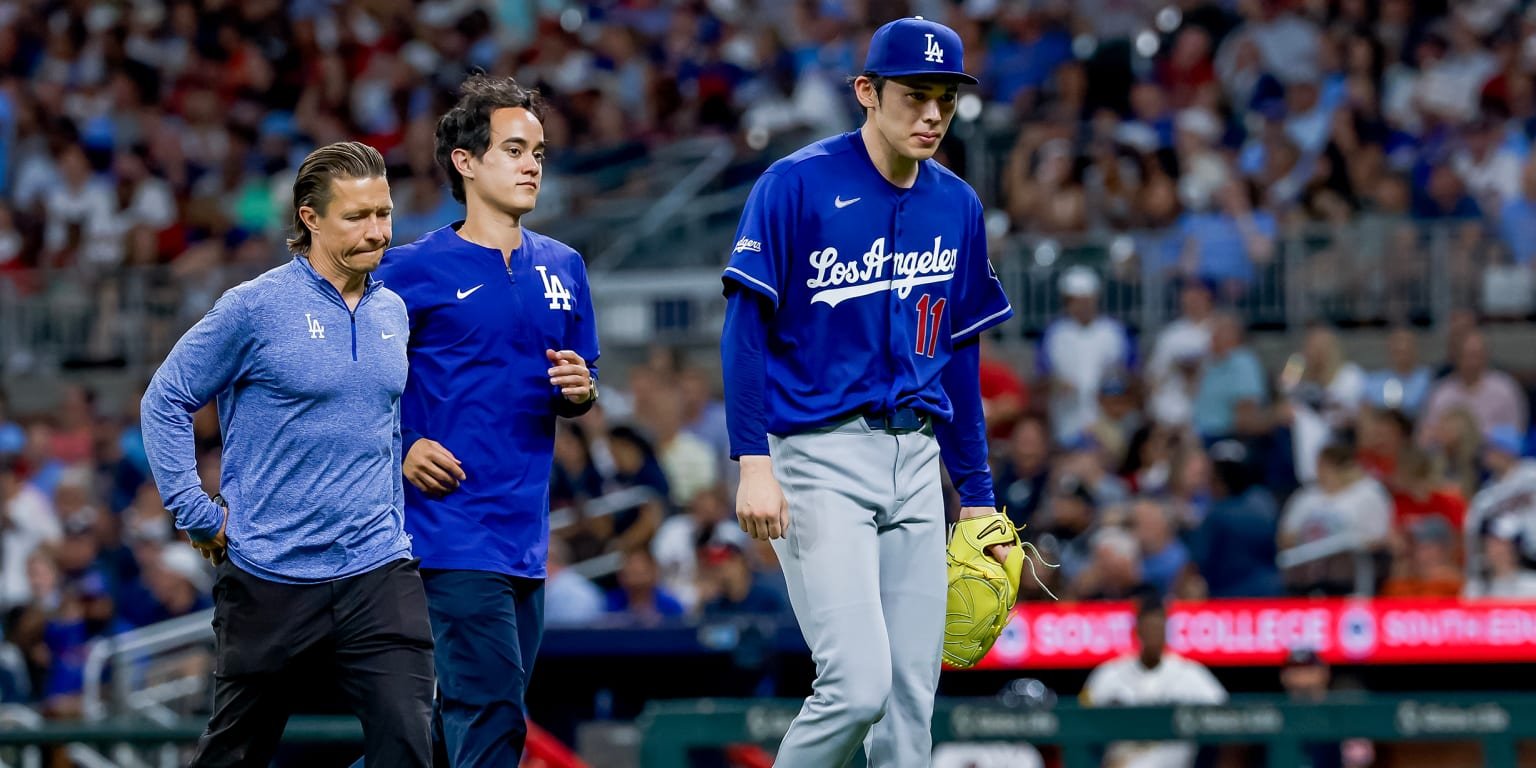
Just as the Los Angeles Dodgers were beginning to see their starting rotation return to health, another pitcher is headed to the injured list.
Manager Dave Roberts confirmed Wednesday night that Roki Sasaki will be placed on the 15-day injured list after developing a blister on the middle finger of his right hand during his start against the Atlanta Braves.
Sasaki was forced out in the fourth inning at Truist Park after the skin on his pitching finger suddenly tore. What makes the injury particularly unusual is that Sasaki said he did not feel the blister gradually developing.
There was essentially no warning.
“I actually didn’t feel anything coming beforehand,” Sasaki said through an interpreter. “My skin just ripped off, and after that it kinda got worse.”
That sudden development turned what initially looked like a difficult fourth inning into an injury situation and ultimately ended Sasaki’s night after only 3 1/3 innings.
Now it will cost him at least one turn through the Dodgers’ rotation.
Sasaki Says Blister Developed Without Warning
Sasaki has dealt with blisters before.
He told reporters after Wednesday’s game that he experienced similar problems while pitching in Japan, but those incidents developed differently. In the past, Sasaki could sense something happening to the finger before the blister became serious.
Wednesday was different.
According to Sasaki, he first felt the skin tear while facing Ozzie Albies to begin the bottom of the fourth inning. A layer of skin initially remained in place, allowing him to continue pitching.
Three batters later, however, the skin had torn more severely.
That progression helps explain why the problem was not immediately obvious when Sasaki returned to the mound for the fourth.
He walked Albies to begin the inning before allowing a single to Mike Yastrzemski. Austin Riley followed with a sacrifice fly, and Sean Murphy then hit a ground-rule double that put runners at second and third.
At that point, pitching coach Mark Prior came to the mound.
The visit quickly became more than an ordinary pitching conference.
Catcher Hunter Feduccia and interpreter Will Ireton were involved as the Dodgers examined Sasaki’s hand. Head athletic trainer Thomas Albert eventually joined them, followed by Roberts.
The focus was Sasaki’s right middle finger.
Moments later, his night was over.
Roberts Confirms Sasaki Is Going on the IL
There was some initial uncertainty about whether the blister would simply force Sasaki to miss his next scheduled start.
Roberts eliminated that uncertainty after the game.
The Dodgers manager confirmed that Sasaki will be placed on the 15-day injured list.
Roberts described it as a significant blister and said its sudden appearance surprised the organization, particularly because there had been little indication that Sasaki was dealing with a finger problem beforehand.
MLB’s official Dodgers coverage subsequently updated its injury report to state that Sasaki is headed to the 15-day IL.
The exact length of his absence remains uncertain.
A 15-day IL placement establishes the minimum period Sasaki will be unavailable, but blisters can be difficult to project because healing depends on how quickly the damaged skin recovers and whether the problem returns once a pitcher begins throwing at full intensity again.
Roberts acknowledged that the Dodgers do not yet know exactly how long Sasaki will need.
For now, the priority is allowing the finger to heal.
Sasaki Can Still Keep His Arm Moving
There is at least one encouraging detail regarding Sasaki’s rehabilitation.
According to ESPN’s postgame reporting, the Dodgers believe Sasaki can continue playing catch while the finger is bandaged. That would allow him to maintain some level of throwing activity rather than completely shutting down his arm.
That could prove important.
A pitcher who spends two weeks without throwing at all may require additional time to rebuild arm strength and workload after the original injury heals.
If Sasaki can safely continue playing catch, the Dodgers may be able to preserve more of his conditioning during the IL stint.
But throwing a baseball casually is very different from throwing a Major League splitter or slider at full intensity.
The middle finger plays an important role in how a pitcher grips and releases multiple pitches. Any damaged skin can affect pressure, feel, spin and command.
That appeared to become a problem Wednesday.
ESPN reported that the blister affected Sasaki’s ability to command his slider as the fourth inning progressed.
For the Dodgers, simply waiting until the finger no longer hurts will not necessarily be enough.
They will need to know Sasaki can grip his pitches normally and throw them aggressively without reopening the damaged area.
Injury Cut Short What Had Been a Strong Second Half
The timing is particularly frustrating because Sasaki had been pitching some of his best baseball of the season.
He entered Wednesday with a 2.31 ERA over his previous six starts since the All-Star break, according to MLB.
That represented meaningful progress for the 24-year-old.
Sasaki’s transition to the Major Leagues has not always been smooth, but his recent stretch had provided growing evidence that he was beginning to establish himself in the Dodgers rotation.
He entered Wednesday’s start with a 5-5 record, a 4.42 ERA and 114 strikeouts on the season.
The Atlanta outing pushed his season ERA to 4.60 after he was charged with four runs.
Those numbers require some context, though.
Sasaki had allowed only one run through his first three innings Wednesday. Matt Olson’s solo home run in the first accounted for the only damage before the blister emerged in the fourth.
Once the finger became compromised, Sasaki’s command deteriorated and Atlanta began putting runners on base.
He finished with 3 1/3 innings, six hits, four earned runs, two walks and three strikeouts on 66 pitches.
Two runners he left on base also scored after his departure.
The final pitching line therefore looks considerably worse than his performance did before the blister became a factor.
Dodgers Rotation Takes Another Injury Hit
Sasaki’s IL trip comes at a strange moment for a Dodgers rotation that appeared to finally be approaching full strength.
Blake Snell recently returned from elbow surgery and has pitched extremely well.
Tyler Glasnow came off the 60-day injured list Tuesday and made his first Major League start since May.
Shohei Ohtani is nearing a possible return to pitching and could potentially take the mound within the next several days if his throwing progression remains on schedule.
Tarik Skubal and Yoshinobu Yamamoto remain established members of the rotation.
For a brief period, Los Angeles appeared close to having more healthy starting pitchers than available rotation spots.
Sasaki’s injury changes that equation again.
MLB described the blister as a setback for a rotation that had expected to reach full strength with Ohtani approaching his return.
The Dodgers still have considerable depth, but losing Sasaki removes one of the pitchers who had been trending in the right direction at exactly the time the club wanted to evaluate its postseason options.
Eric Lauer Expected to Return to Rotation
The immediate replacement appears to be straightforward.
Roberts indicated that Eric Lauer is expected to move back into the starting rotation while Sasaki is unavailable.
Lauer had only recently shifted into a relief role because the Dodgers were getting healthier.
He pitched two innings out of the bullpen Wednesday after Sasaki’s early departure, allowing one run.
Now the left-hander is likely to resume starting.
That gives Los Angeles an experienced replacement without having to immediately promote a starter from the Minor Leagues or significantly disrupt the rest of its rotation.
It also demonstrates why the Dodgers have been reluctant to view starting-pitching depth as a problem.
Circumstances can change almost immediately.
One day a pitcher can be pushed to the bullpen because there are too many healthy starters.
The next day he can be needed in the rotation again.
Sasaki’s blister created exactly that situation.
Could Sasaki’s Role Change When He Returns?
There is also a longer-term question surrounding what role Sasaki will occupy once his finger heals.
That answer may depend on how long he is unavailable.
ESPN reported that if Sasaki’s absence extends beyond the minimum IL period, the Dodgers could eventually consider bringing him back in a relief role rather than rebuilding him as a traditional starter.
That possibility would make sense in the context of October.
The Dodgers already have multiple established starting options, including Skubal, Yamamoto, Snell and Glasnow. If Ohtani successfully completes his pitching buildup, the rotation picture becomes even more crowded.
Sasaki also has experience providing high-leverage relief.
His potential postseason role therefore does not necessarily depend on returning to a six-inning starter’s workload.
But it is too early to determine that now.
The Dodgers first need the skin on his finger to heal.
Only after Sasaki resumes throwing his complete arsenal can Los Angeles decide whether there is enough time to rebuild him as a starter or whether a shorter role makes more sense.
Blisters Can Be Particularly Complicated for Pitchers
A blister sounds minor compared with elbow, shoulder or ligament injuries.
For a pitcher, however, it can become a significant problem.
Pitching requires repeated friction between the baseball, fingertips and seams. A damaged section of skin can affect both comfort and control, particularly on pitches that require precise finger pressure at release.
Trying to pitch through a blister can also risk tearing the skin further.
That appears to be what happened with Sasaki Wednesday.
The first tear did not immediately force him out.
He initially continued pitching because some skin remained over the affected area. By the time Murphy doubled three batters later, the tear had worsened enough that continuing was no longer realistic.
That is why the Dodgers cannot simply cover the finger and send Sasaki back to the mound in a few days.
The tissue has to recover enough to tolerate the repeated friction generated by a full pitching workload.
And because Sasaki said this blister appeared differently from ones he experienced in Japan, there may not have been an obvious opportunity to intervene before it tore.
Dodgers Will Have to Be Patient
The frustrating part for both Sasaki and Los Angeles is that there may not be much to do except allow the healing process to happen.
He can maintain some arm activity.
The Dodgers can monitor the finger.
They can protect the damaged skin and gradually test his grip as it heals.
But they cannot force new skin to develop faster simply because the postseason race is entering its final month.
The organization also has little reason to rush him.
Los Angeles has enough rotation depth to cover the innings.
The more important objective is making sure Sasaki does not return too early, reopen the blister and turn a relatively short absence into a recurring September problem.
Blister problems can become especially frustrating when they repeatedly heal and reopen.
The Dodgers will want to avoid that cycle.
A Sudden Setback at an Unfortunate Time
Perhaps the most frustrating part of Sasaki’s injury is how little warning anyone received.
This was not a pitcher who had been managing a blister for several outings.
According to Sasaki, he did not feel the usual signs that one was developing.
The skin simply tore.
Roberts echoed that surprise afterward, saying the problem essentially came “out of nowhere.”
Within the span of a single inning, Sasaki went from trying to protect a Dodgers lead to leaving the mound with trainers examining his pitching hand.
Within hours, Roberts confirmed he was going to the injured list.
It interrupts one of Sasaki’s most encouraging stretches of the season and temporarily removes him from a Dodgers rotation that had only just begun getting its injured starters back.
There is no firm return date yet.
There is no guarantee Sasaki will immediately rejoin the rotation when he is eligible.
But there is also no indication at this point of a structural arm injury or anything more serious than the damaged skin on his right middle finger.
For now, that is the encouraging part.
Roki Sasaki’s strong second-half run has been interrupted by an injury that seemingly appeared without warning. The Dodgers now have to hope two weeks of healing is enough to make the blister a temporary setback rather than a lingering issue heading toward October.