
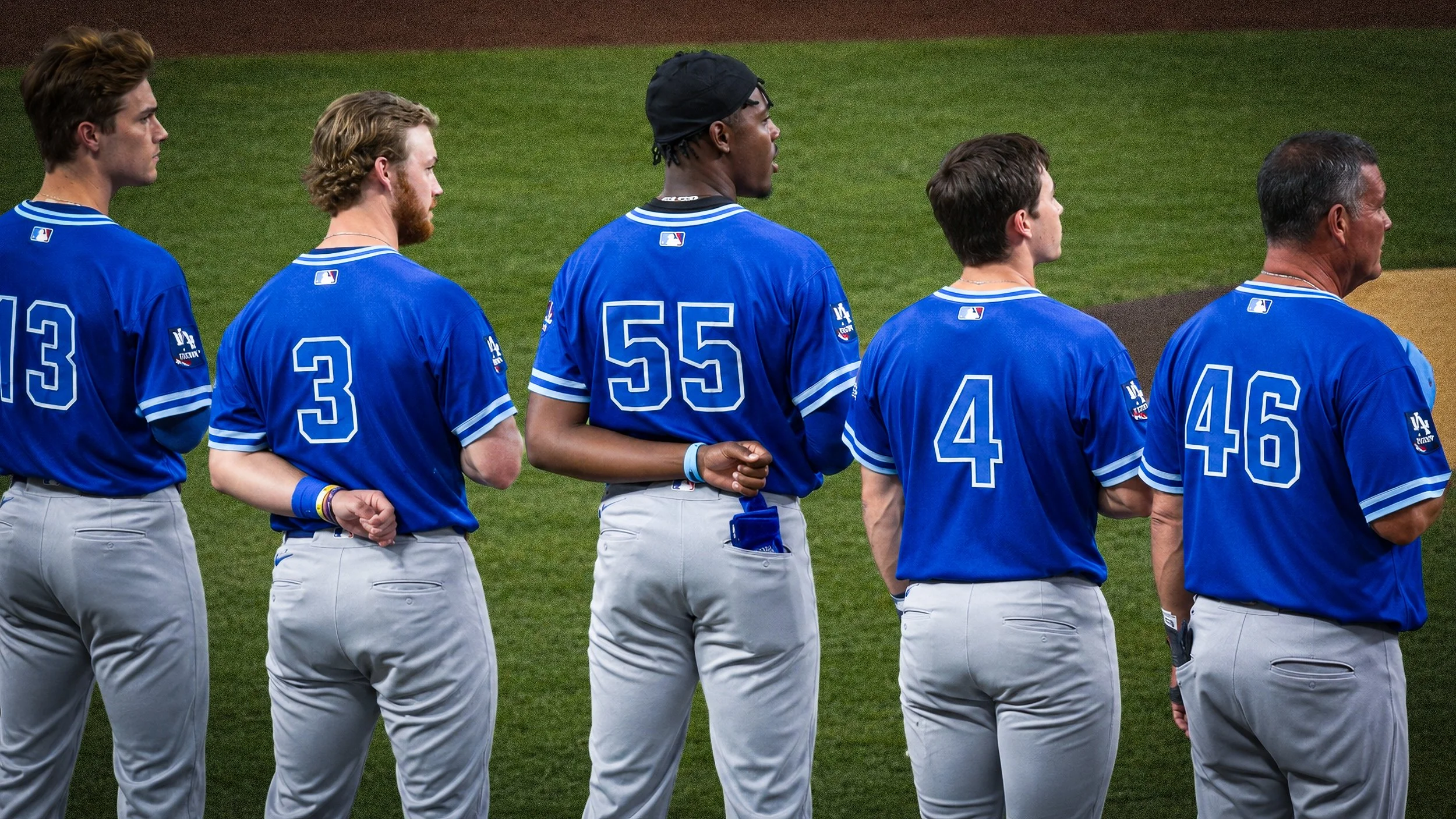
The Dodgers understand that their roster needs to become younger.
Katie Woo just does not expect the entire transition to happen this offseason.
During Wednesday’s Dodgers AMA on Reddit, Woo explained that she and Fabian Ardaya both asked Andrew Friedman about the club’s aging roster during his end-of-season press conference.
After reading between the lines of Friedman’s responses, Woo believes the Dodgers are aware of their age but remain confident in the established players already under contract.
“I think 2028 will be the season we see major change,” Woo wrote.
Her interpretation is that 2027 will be more about getting younger around the edges and preparing for a larger transition the following season.
That is not an announced Dodgers plan.
It is, however, an interpretation that makes sense when examining the roster, its guaranteed contracts and the decisions Los Angeles will face after next season.
Dodgers Cannot Change Everything Immediately
The Dodgers finished 2026 with the oldest position-player group in baseball.
That reality has already led to calls for Josue De Paula, Alex Freeland, Mike Sirota and other young players to receive meaningful opportunities in 2027.
But getting younger without wasting the current championship window is more complicated than replacing several veterans at once.
Shohei Ohtani, Mookie Betts, Will Smith and Kyle Tucker are under long-term contracts. Freddie Freeman, Max Muncy, Teoscar Hernández and Tommy Edman remain important parts of the roster.
The Dodgers cannot simply remove productive veterans because younger players are approaching the majors.
They also should not continue blocking every prospect until injuries create temporary opportunities.
That makes a gradual transition more realistic.
Los Angeles can introduce younger players in limited or shared roles during 2027, evaluate how they respond and then make more significant decisions after the season.
Why 2028 Could Become A Turning Point
Several important contracts will reach decision points following the 2027 season.
Freeman will enter the final guaranteed year of his six-year contract next season. He has previously expressed interest in continuing his career with the Dodgers, but no extension has been announced.
The Dodgers hold a club option on Muncy for 2028.
Hernández’s guaranteed contract also runs through 2027, followed by a 2028 option. The Dodgers must determine whether to keep him, trade him or create a larger role for De Paula.
Tucker can opt out of his contract after the 2027 season. Tyler Glasnow’s deal also includes an option structure for 2028, while Los Angeles must decide whether to exercise its 2028 options on Hyeseong Kim.
None of those contract situations guarantees a departure.
They do give the Dodgers considerably more flexibility after next season than they possess right now.
By 2028, De Paula, Freeland and Sirota should also have more information available about their readiness for everyday roles. Other prospects such as Charles Davalan, Mike Sirota and James Tibbs III could be closer to becoming legitimate Major League options.
The combination of contract decisions and prospect development could make 2028 a natural point for the organization to reshape its position-player core.
Catching Depth Could Become A Short-Term Priority
Woo also identified catching depth as a possible offseason need.
Dalton Rushing underwent right-elbow surgery to repair a partially torn ulnar collateral ligament. His estimated recovery period before returning to catching is approximately nine months, although he is expected to resume hitting earlier.
If his recovery follows that timeline, Rushing may not be cleared to catch until the middle or second half of the 2027 season.
That leaves Will Smith and Hunter Feduccia as the Dodgers’ leading catching options entering next season. Eliezer Alfonzo is currently behind them on the depth chart but has only 13 games of Major League experience.
Woo emphasized that she was wondering whether catching would become a priority. She was not reporting that the Dodgers have decided to acquire another catcher.
The need is nevertheless legitimate.
Smith has dealt with injuries, and Rushing’s setback removes the club’s most obvious alternative for handling a larger share of the catching workload.
A veteran capable of backing up Smith without requiring a long-term commitment would fit the idea of a smaller 2027 adjustment.
Such a move would protect the Dodgers while allowing Rushing to complete his recovery without being rushed back behind the plate.
A Stopgap Infielder Could Create More Flexibility
Second base represents another area where the Dodgers could make a targeted move without committing to a complete infield overhaul.
Dodgers second basemen combined for a .676 OPS in 2026, the lowest total produced by any defensive position on the team.
Edman currently sits atop the depth chart, with Freeland and Kim among the internal alternatives.
Woo believes the Dodgers could add a stopgap infielder who would allow Edman to return to the versatile role in which he has provided his greatest value.
Edman can play second base, shortstop, center field and other positions when necessary. Locking him into one position every day reduces the flexibility that has made him so useful.
Adding another infielder could also give Freeland opportunities without forcing the Dodgers to hand him the starting second-base job immediately.
Freeland appeared at second base, shortstop and third base in 2026. Miguel Rojas’ retirement creates a possible utility opening, but Freeland still must prove that his bat can produce consistently at the Major League level.
A short-term addition would allow Los Angeles to evaluate Freeland gradually while retaining alternatives if he struggles.
Again, Woo presented this as a possibility—not a move she has been told the Dodgers will make.
Mookie Betts Is Not Expected To Move Yet
Woo also addressed speculation about moving Betts from shortstop to second base.
She believes another position change is probably inevitable at some point, but does not think the Dodgers have reached that stage yet.
That distinction matters.
Betts experienced another inconsistent offensive season in 2026, but his shortstop defense remained strong. He finished with nine outs above average and ranked in the 94th percentile defensively.
Moving him to second base would not automatically solve the infield.
The Dodgers would still need to acquire or develop another shortstop, and Betts would once again have to adjust to a different defensive assignment.
Unless Los Angeles acquires a clear long-term shortstop, keeping Betts where he has established defensive value appears reasonable.
A future move to second could still become part of the larger 2028 transition Woo envisions.
It simply does not appear imminent.
Getting Younger Around The Margins
Woo’s assessment does not mean the Dodgers will run back the same roster in 2027.
It suggests the first phase of the transition could involve several controlled changes rather than an immediate teardown of the veteran core.
That could mean:
Giving De Paula regular opportunities without depending on him to carry the lineup.
Using Freeland in a utility role before deciding whether he can become an everyday infielder.
Allowing Sirota more time at Triple-A while keeping him close to a Major League opportunity.
Adding short-term catching depth while Rushing recovers.
Acquiring an infielder without immediately moving Betts away from shortstop.
Reducing veteran workloads through deeper and more flexible roster construction.
The Dodgers can become younger without asking several inexperienced players to adjust to the majors simultaneously.
They can also learn which prospects deserve to become part of the next core before making more permanent decisions in 2028.
The Dodgers Still Need To Compete In 2027
A gradual transition should not be mistaken for a bridge year.
The Dodgers won 100 games in 2026 and remain capable of pursuing another championship. Ohtani, Betts, Freeman, Tucker and Smith still give Los Angeles the foundation of an elite lineup.
The challenge is building enough depth around them to prevent the same veterans from carrying the entire physical burden of another long season.
That is why smaller additions at catcher and infield could matter.
Neither move would attract as much attention as a Tarik Skubal contract or blockbuster trade. Both could make the roster more functional while the Dodgers evaluate their younger players.
The front office must balance two timelines:
Winning another World Series with the existing core and preparing the players expected to replace that core.
Our Take
Woo’s 2028 timeline makes sense because the Dodgers will have far more contractual flexibility after next season.
Freeman’s contract expires. Muncy and Hernández reach option decisions. Tucker can opt out. Several prospects should be closer to proving whether they belong in Los Angeles.
That does not mean the Dodgers should wait until 2028 to begin changing.
De Paula and Freeland need real opportunities in 2027. Catching depth requires attention after Rushing’s surgery. Second base remains unsettled, and Edman’s versatility becomes more valuable when he is not locked into one position.
The best approach is a controlled transition.
The Dodgers should remain aggressive enough to contend in 2027 while beginning to identify which young players can become part of the next version of the team.
The major roster shift may not arrive until 2028, but the decisions that shape it begin this offseason.
Which young Dodgers player should receive the biggest opportunity in 2027?