
The Dodgers’ offseason cannot be reduced to one free-agent signing or one blockbuster trade.
Their real challenge is more complicated.
Los Angeles must begin transitioning away from one of baseball’s oldest rosters without wasting another season of a championship window built around Shohei Ohtani, Mookie Betts and Freddie Freeman.
That central conflict drove a recent discussion between Austin Brubaker and Coach Mark Berokoff on Blue Dynasty Breakdown.
The Dodgers remain talented enough to win the 2027 World Series. They are not approaching a rebuild, nor should they be.
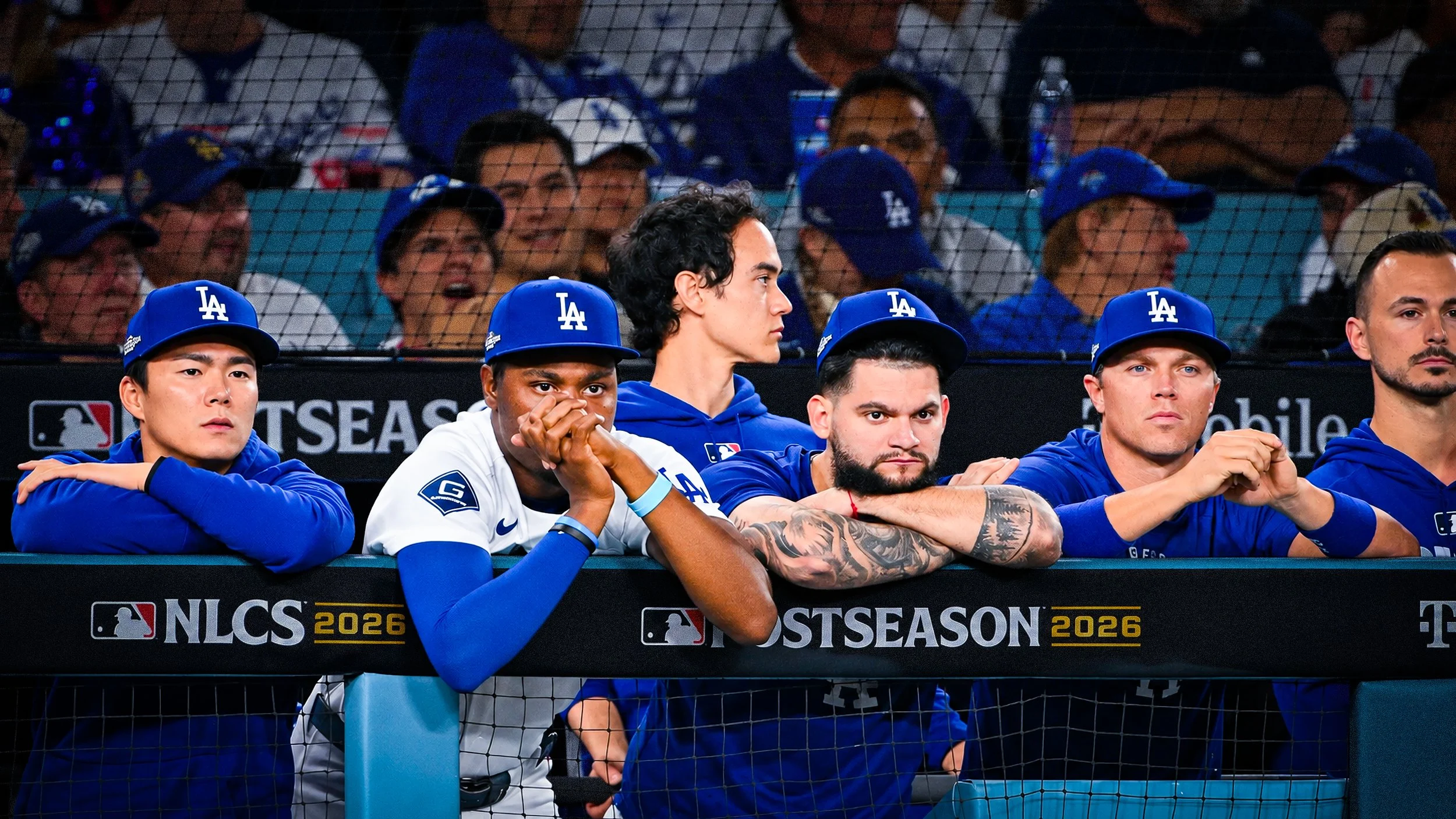
But their NLCS sweep exposed legitimate questions about age, durability, lineup construction and whether the organization has waited too long to create meaningful roles for its younger players.
The answer cannot be to abandon the current core.
It also cannot be to run everything back unchanged.
Los Angeles Still Has A Championship Team
A disappointing ending should not erase what the Dodgers accomplished.
They finished 100-62, won the National League West and reached the NLCS for the third consecutive year. Milwaukee swept them, but the Brewers ultimately proved they were the best team in baseball by winning the World Series. www.baseball-reference.com
Berokoff did not consider the Dodgers’ season a failure.
He argued that winning consecutive championships may have distorted expectations around the team. Los Angeles attempted something no National League club had accomplished in the modern era, and winning a third straight title was always going to be extraordinarily difficult.
That perspective is fair.
The Dodgers did not suddenly become a bad organization because they lost four games to Milwaukee. They remain one of baseball’s deepest teams and should enter next season among the World Series favorites.
The concern is not whether they can compete in 2027.
It is whether they can continue competing beyond it without a painful transition.
Age And Accumulated Workload Are Becoming Factors
The Dodgers’ veteran core has played an enormous amount of baseball over the last several seasons.
Consecutive World Series runs, international travel, World Baseball Classic participation and another deep October push created a workload that eventually may have caught up with them.
Berokoff, drawing from his experience coaching three consecutive national championship teams, explained how difficult it becomes to maintain the same physical and emotional energy during an extended run of success.
Age does not explain everything that went wrong.
It cannot be ignored, either.
Freeman, Betts, Max Muncy and Teoscar Hernández have accumulated thousands of major-league plate appearances. Will Smith has absorbed the physical demands of catching throughout multiple postseason runs. Ohtani is attempting to remain an elite hitter while preparing to pitch again.
The Dodgers have also repeatedly navigated injuries throughout their rotation.
Their veterans are still capable of producing at a high level. The question is whether the organization can continue asking the same group to carry nearly the entire burden through another 162-game schedule and postseason.
Getting Younger Requires More Than Promoting Prospects
Josue De Paula represents the clearest opportunity to introduce younger talent into the lineup.
The 21-year-old reached base 18 times through his first 38 major-league plate appearances after producing an MVP season at Double-A Tulsa. His bat appeared capable of helping the Dodgers immediately.
But giving De Paula a permanent roster spot would only be the first step.
Young players need regular at-bats to develop.
Placing De Paula, James Tibbs III or another prospect on the bench behind established veterans would technically make the roster younger without accomplishing much developmentally.
The Dodgers must decide which young players they truly believe can help them and then create defined opportunities for those players.
That could require reducing a veteran’s role, using more aggressive platoons or accepting short-term struggles while a prospect adjusts to major-league pitching.
Berokoff raised the other side of that argument.
Fans frequently demand opportunities for prospects but can become impatient when those same players struggle. A genuine youth movement requires tolerance for mistakes that a championship contender may not always be able to afford.
That is why Los Angeles needs a middle path.
The Dodgers should not turn over several everyday positions at once, but they cannot continue blocking every prospect until an injury creates playing time.
Trading Teoscar Hernández May Create A New Weakness
Hernández has become the most obvious veteran connected to the Dodgers’ effort to get younger.
Trading him could open left field for De Paula, improve the defense and remove a significant salary from the roster.
It could also make one of the Dodgers’ biggest offensive weaknesses even worse.
As Brubaker highlighted during the Breakdown discussion, Los Angeles hit only .172 with a .471 OPS against left-handed pitching during the postseason. The Dodgers produced a .217 average and .704 OPS against right-handers. newsespn.pages.dev
Hernández remains one of their most established hitters against left-handed pitching.
Replacing him with De Paula would exchange a right-handed bat for another left-handed hitter. De Paula’s overall upside may be higher, but expecting him to immediately replace Hernández’s production against lefties would be an enormous demand.
That does not mean the Dodgers should guarantee Hernández an everyday position.
His defense remains a concern, and the Dodgers must find more playing time for De Paula if they believe the young outfielder is ready.
But trading Hernández cannot be treated as a complete solution.
If he leaves, Los Angeles will need to add another hitter who can punish left-handed pitching. Otherwise, opposing teams will have an obvious plan for attacking the Dodgers in October.
A shared arrangement involving Hernández, De Paula and Kyle Tucker could be more realistic than immediately choosing one player over another.
Tarik Skubal Represents The Win-Now Side
No decision represents the Dodgers’ current championship ambitions more clearly than Tarik Skubal’s free agency.
Skubal posted a 2.61 ERA with 70 strikeouts in 62 innings after joining Los Angeles. He also allowed three earned runs across 11 postseason innings.
Berokoff’s position was simple: pay him.
The Dodgers would be retaining a two-time Cy Young Award winner who has already proven he can pitch in Los Angeles and handle October.
The opposing argument is about resource allocation.
Los Angeles already has Yoshinobu Yamamoto, Ohtani, Blake Snell, Tyler Glasnow, Roki Sasaki and Emmet Sheehan among its rotation possibilities. Skubal’s next contract could exceed $400 million at a time when the future financial structure of baseball is uncertain.
The Dodgers do not necessarily need another starting pitcher.
They may still need Skubal.
Ohtani’s pitching workload must be managed. Snell and Glasnow have dealt with injuries. Sasaki has not yet demonstrated that he can provide a complete major-league season.
Skubal would give Los Angeles another dependable ace and reduce the need for every other rotation plan to work perfectly.
Signing him would be an aggressive commitment to winning now.
It would also consume resources that could address the bullpen, infield or lineup.
The Bullpen Needs More Than Familiar Names
Alex Vesia, Evan Phillips, Brusdar Graterol and Blake Treinen are among the Dodgers relievers testing free agency.
Each decision involves a balance between familiarity and reliability.
Vesia offers left-handed swing-and-miss ability and has become an important part of the clubhouse. Berokoff described him as a combination of culture and performance that would be difficult to replace.
Phillips has been particularly effective against right-handed hitters, but his recent health history creates uncertainty.
Graterol remains electric when available, although availability has become the central issue. Treinen is entering his age-39 season and finished the year with a shoulder injury.
The Dodgers should not re-sign relievers simply because they are familiar.
They also should not assume their pitching operation can cheaply recreate every departure.
Los Angeles needs bullpen arms capable of missing bats, limiting walks and remaining available through October. Some of those answers may come from within the organization, but replacing the entire group externally would create additional risk.
Miguel Rojas’ Leadership Must Also Be Replaced
Rojas’ retirement creates a loss that will not appear in statistical projections.
He helped Betts adjust to shortstop, worked closely with younger players and became one of the clubhouse’s most respected voices. His game-tying home run in Game 7 of the 2025 World Series ensured his place in Dodgers history, but his daily leadership may be more difficult to replace.
That makes Kiké Hernández’s free agency more interesting.
Hernández’s regular-season production has declined, and the Dodgers could find a more productive bench player.
What they may not easily find is someone willing to accept an inconsistent role while maintaining energy, accountability and connection throughout the clubhouse.
Berokoff initially argued that the Dodgers should let Hernández leave before reversing course and explaining why he wants him back.
The playful debate revealed a legitimate question.
How much should the Dodgers value culture when the roster also needs greater production and athleticism?
The answer should not be that leadership overrides performance. It should be that the Dodgers must understand what they are losing before they replace it.
The Dodgers Need A Controlled Transition
The Dodgers should not tear down a roster that won 100 games.
They also should not confuse past success with proof that the same approach will continue working indefinitely.
Their best offseason would combine both timelines:
Retain or acquire enough elite talent to pursue the 2027 World Series.
Create regular opportunities for De Paula and other young players.
Improve the lineup against left-handed pitching.
Add durable arms instead of relying exclusively on injured veterans.
Replace the leadership lost with Rojas’ retirement.
Maintain enough flexibility to continue evolving beyond next season.
That is more difficult than simply signing the most expensive free agent.
The Dodgers’ next championship team will probably include many of the players who won in 2024 and 2025.
It must also begin introducing the players expected to carry the organization after that core is gone.
Los Angeles does not need to choose between winning now and building for later.
Its offseason challenge is finding a credible way to do both.
Which young Dodgers player most deserves a meaningful role in 2027?