
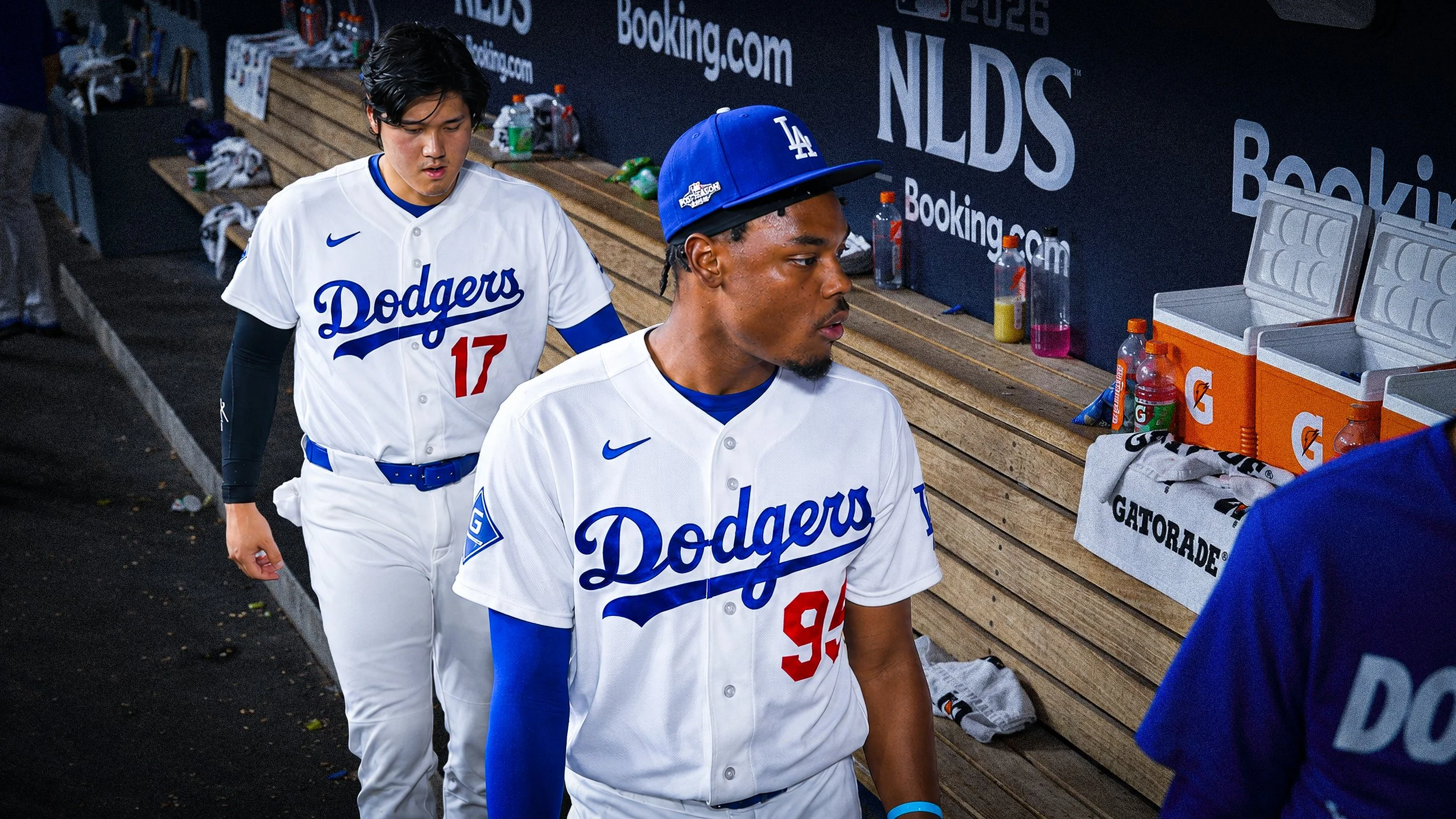
The Dodgers do not lack star power.
Shohei Ohtani, Mookie Betts, Freddie Freeman, Yoshinobu Yamamoto, Blake Snell, Tyler Glasnow, Kyle Tucker and Edwin Díaz already give Los Angeles more established talent than almost any organization in baseball.
That did not carry the Dodgers to another championship in 2026.
The natural reaction following a disappointing postseason is to search for the next massive acquisition. Elly De La Cruz has already become a popular name in speculative trade conversations, and the Dodgers will inevitably be connected to nearly every prominent player available this offseason.
Austin Brubaker reached a different conclusion during the latest episode of Blue Dynasty Breakdown.
After compiling the Dodgers’ 2027 Steamer projections and examining their offensive and pitching splits, Austin argued that the current roster does not need to be rebuilt around another superstar. It needs to become more balanced.
That means finding another hitter who can punish left-handed pitching, adding bullpen help capable of neutralizing left-handed batters and creating legitimate opportunities for the organization’s young players.
Those needs may not generate the loudest offseason headlines.
They could still determine whether the Dodgers are better prepared for October.
Dodgers’ Projected Offense Remains One Of Baseball’s Best
The early Steamer projections give the Dodgers a 115 team wRC+, meaning their current group is projected to perform approximately 15 percent better than the league-average offense.
That is not the profile of a broken lineup.
There is, however, a noticeable split. Los Angeles projects for a 117 wRC+ against right-handed pitching and a 110 mark against left-handers.
A 110 wRC+ is still comfortably above average. Austin’s concern is not that the Dodgers cannot hit lefties—it is that their advantage becomes smaller when opponents turn to left-handed pitching.
That matters because postseason opponents can build their pitching plans around a lineup’s relative weaknesses.
As we previously examined in our breakdown of the Dodgers’ early 2027 projections, Ohtani is projected for a 145 wRC+ overall and a dominant 155 mark against right-handers. Freddie Freeman and Josue De Paula are also projected to do more damage against right-handed pitching.
The Dodgers already possess plenty of left-handed offensive firepower.
The challenge is maintaining that same pressure when a left-hander enters the game.
Trading Teoscar Hernández Would Create Another Need
Opening an everyday outfield position for De Paula is one of the strongest arguments for trading Teoscar Hernández.
De Paula is projected for a 111 wRC+ overall, including a 116 mark against right-handed pitching. Those numbers support the belief that his bat could already help the Dodgers in 2027.
But the same projection gives De Paula a 93 wRC+ against left-handers.
Hernández projects for a more modest 105 overall mark, but his projected 120 wRC+ against left-handed pitching is one of the best on the current roster. He also hit .303/.392/.515 against lefties during the 2026 regular season.
That does not mean the Dodgers must keep Hernández.
His defense, contract and declining overall production all belong in the discussion. The Dodgers also need to create meaningful opportunities for De Paula and Mike Sirota instead of allowing their young outfielders to remain blocked indefinitely.
It does mean that moving Hernández cannot be evaluated solely by the roster spot it opens.
If the Dodgers trade him, they must have a plan to replace what he provides against left-handed pitching.
That replacement could come through the trade return, a separate offseason acquisition or a complementary player capable of starting against lefties. Simply inserting another left-handed hitter into the lineup could make its existing imbalance even more pronounced.
Second Base May Not Require A Major Acquisition
Second base remains another area the Dodgers could address, but Austin questioned whether it represents a position worth forcing an expensive solution.
Steamer projects Tommy Edman for a 92 wRC+ and Alex Freeland for a 93 mark. Neither forecast is especially exciting offensively, but both players provide defensive value and positional flexibility.
An Edman-Freeland combination could give the Dodgers adequate production without surrendering significant prospect capital or committing substantial money to a stopgap.
Freeland would receive the opportunity to establish himself against Major League pitching. Edman could move around the field according to matchups, injuries and defensive needs.
Hyeseong Kim’s projected 72 wRC+ creates more uncertainty about his offensive role, but he can still contribute with his speed and defensive versatility.
The Dodgers should explore improvements. They should not make an acquisition simply for the sake of announcing one.
Bullpen Balance May Be The Clearest Need
Austin’s pitching analysis revealed a similar split in the bullpen.
Dodgers relievers are projected for a 16.8 percent strikeout-minus-walk rate against right-handed hitters, compared with 15.3 percent against lefties.
That difference is not overwhelming, but much of the projected production against left-handers comes from Tanner Scott and Jack Dreyer. Scott carries a projected 28.7 percent strikeout-minus-walk rate against lefties, while Dreyer checks in at 20 percent.
Remove Scott from the equation because of an injury or poor stretch, and the bullpen becomes considerably less imposing against left-handed hitters.
That makes Alex Vesia one of the more logical free-agent reunions for Los Angeles.
Vesia is projected to record a 3.71 ERA with a 27.4 percent strikeout rate in 2027. FanGraphs also identified him as one of the most productive left-handed relievers of the current decade. FanGraphs Baseball
Evan Phillips would provide another experienced option if the Dodgers are comfortable with his health and recovery.
The answer does not necessarily have to be a left-handed pitcher. What matters is adding someone with a dependable method for retiring left-handed batters.
That is a far more specific objective than simply saying the Dodgers need “another reliever.”
Emmet Sheehan Deserves A Larger Opportunity
The rotation is where the Dodgers may already have their next major contributor.
Steamer projects Emmet Sheehan for an 18.3 percent strikeout-minus-walk rate, placing him alongside Yamamoto, Snell, Glasnow and Ohtani in Austin’s analysis.
Projections cannot guarantee that Sheehan will remain healthy or successfully handle a full starting workload. They do show why the Dodgers should create a real opportunity for him instead of treating him exclusively as emergency depth.
Los Angeles has spent heavily to build its rotation, but the organization still needs young, affordable pitchers capable of absorbing meaningful innings.
Sheehan may already be one of them.
Giving him that opportunity could provide more value than adding another veteran starter to an already crowded group.
The Elly De La Cruz Temptation Comes With A Cost
Few players would be more exciting in Dodger blue than Elly De La Cruz.
He is young, athletic and capable of changing a game with his power, speed and arm. He also remains under team control, which is precisely why Cincinnati would demand an enormous return.
Austin acknowledged De La Cruz’s talent but questioned whether the improvement would justify the prospect cost. Any serious negotiation would likely begin with one of the Dodgers’ premier young players and require multiple additional pieces.
That is speculation—not a reported trade package—and the Reds have not indicated that De La Cruz is available.
As we previously explained in our examination of why Cincinnati would be reluctant to trade De La Cruz, the Dodgers would have to present an overwhelming offer for the conversation to become realistic.
The 2026 season also provided an important reminder.
Los Angeles added Tucker and Díaz before acquiring Tarik Skubal during the season. The Dodgers became more talented, but that talent did not guarantee another World Series.
Adding another superstar would improve the roster.
It would not automatically correct every matchup problem, protect the team from injuries or prevent another October offensive collapse.
Christian Zazueta Shows Why The Pipeline Matters
Christian Zazueta represents the other side of that trade discussion.
Austin called Zazueta the best pitching prospect in the Dodgers’ system based on the combination of swing-and-miss ability and command he has seen in person.
The results support that enthusiasm.
Zazueta finished 2026 with a 3.65 ERA, 0.97 WHIP and 144 strikeouts against only 20 walks across 103⅔ innings between High-A Great Lakes and Double-A Tulsa. MLB Pipeline currently ranks him fifth in the Dodgers’ system. Los Angeles Dodgers
Austin believes Zazueta could reach Los Angeles during the 2027 season.
That is Austin’s projection, not a timeline announced by the Dodgers. Zazueta still needs to be protected on the 40-man roster and prove he can handle upper-level hitters consistently.
But he illustrates why the Dodgers cannot treat their farm system merely as currency for established stars.
Zazueta, De Paula, Sirota, Freeland and the organization’s other young players could help extend the current championship window while making the roster younger and more sustainable.
Dodgers Need Precision More Than Another Spending Spree
The Dodgers should remain aggressive.
If an elite player becomes available at a reasonable cost, Andrew Friedman should explore the opportunity. A team trying to win the World Series should never close itself off from acquiring exceptional talent.
But aggression does not always require the largest contract or most dramatic trade.
The projections point toward a more precise offseason plan:
Preserve or replace Hernández’s production against left-handed pitching.
Add another reliever capable of neutralizing left-handed hitters.
Give Sheehan a meaningful rotation opportunity.
Create legitimate playing time for De Paula, Freeland and other young players.
Avoid sacrificing too much of the farm system for a move that does not directly solve the roster’s most important weaknesses.
The Dodgers are not one superstar away from becoming talented enough to win.
They are already talented enough.
Their challenge is building a roster whose pieces complement one another—and whose younger players are finally trusted to become part of the solution.
Would you rather see the Dodgers make one blockbuster acquisition or use those resources on several targeted additions?