
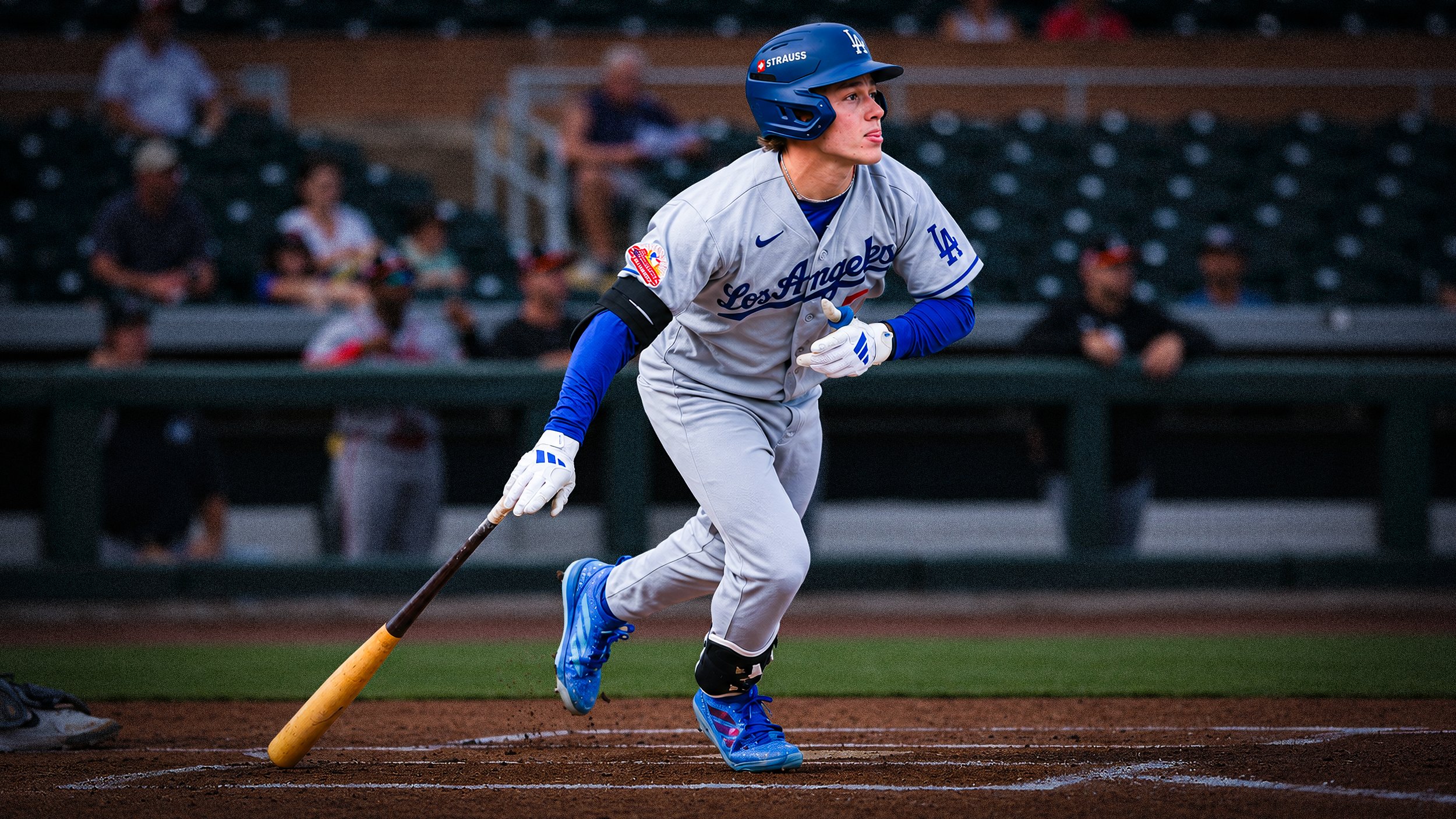
Charles Davalan’s return to second base was initially easy to view as another example of the Dodgers expanding a prospect’s versatility.
A new scouting assessment raises a more complicated question.
Could learning the position eventually help Davalan reach Los Angeles—or could the additional defensive work slow down one of the organization’s fastest-rising hitters?
Baseball America’s Ian Cundall recently evaluated Davalan’s work at second base during the Arizona Fall League. Cundall observed that Davalan has generally converted the routine plays but remains raw with his range, reactions and reads off the bat.
The assessment does not mean the Dodgers have decided Davalan cannot play second base.
It shows how much development may be required before the position becomes a legitimate part of his path to the majors.
Davalan Is Revisiting A Familiar Position
As we previously covered when Davalan began receiving work at second base, the position is not entirely new to him.
He played second during his freshman season at Florida Gulf Coast in 2024 before transferring to Arkansas and moving primarily to the outfield.
The Dodgers selected him with the 41st overall pick in the 2025 MLB Draft. He then played exclusively in the outfield during his first full professional season before returning to second with the Glendale Desert Dogs.
Baseball America reported that the Dodgers are exploring the position partly because of the organization’s considerable outfield depth.
Josue De Paula, Mike Sirota and Eduardo Quintero rank among the best outfield prospects in baseball. James Tibbs III and Zach Ehrhard have reached Triple-A, while Andy Pages and Kyle Tucker already occupy Major League roles.
Davalan’s bat gives him a chance to force his way through that group.
Second base could give him another route around it.
Baseball America Identified Work Still To Be Done
Cundall’s observations were not entirely negative.
Davalan has handled most of the routine opportunities presented to him. For someone playing the position in games for the first time since 2024, completing the expected plays represents an encouraging starting point.
The concerns involved the plays requiring more instinct and range.
Cundall found Davalan’s reactions to be a step slow at times and questioned whether his physical profile provides the quickness normally associated with the position.
Those details matter because playing second base involves more than fielding ground balls hit directly at a defender.
Davalan must improve his first step, read the ball’s direction off the bat, understand when to charge and learn positioning responsibilities on double plays, relays and defensive shifts.
Those instincts are normally developed through repetition.
Davalan is attempting to acquire them while continuing to advance as a hitter.
Other Evaluators Have Seen More Encouraging Range
Baseball America’s assessment is not the only evaluation of Davalan’s infield work.
FanGraphs offered a somewhat more optimistic view after watching him in Arizona.
Its scouting report found that Davalan appeared capable of moving well in both directions and noted a diving play up the middle that demonstrated more range than expected. The concern was less about his physical ability and more about the finer details of playing the position.
During one routine ground ball, Davalan retreated instead of charging, nearly allowing the hitter to reach safely.
The two evaluations reach different conclusions about his range but identify a similar developmental need.
Davalan must improve his reads and become more comfortable making decisions that experienced second basemen process instinctively.
That is not unusual for someone returning to the position after two years in the outfield.
It also means the Dodgers do not yet have enough information to declare the experiment successful.
His Bat Is Moving Faster Than His Glove
Davalan’s offensive performance is the reason the position question matters.
The 22-year-old dominated the Midwest League during his first full professional season, batting .292/.402/.535 with 24 home runs, 29 doubles and 17 stolen bases for High-A Great Lakes.
He led the league with 128 hits, 29 doubles, 56 extra-base hits and 235 total bases while earning Midwest League MVP honors.
Davalan also demonstrated one of the strongest combinations of contact and power in the Dodgers’ system.
He struck out only 57 times while drawing 63 walks in 115 games with Great Lakes. That level of strike-zone control gives him an offensive foundation that should remain valuable as he faces more advanced pitching.
The Dodgers promoted him to Double-A Tulsa for the final game of the regular season, but he has only five plate appearances above High-A.
MLB Pipeline currently ranks Davalan as the Dodgers’ No. 6 prospect and No. 79 overall. His estimated Major League arrival remains 2028.
That timeline gives the organization room to continue the second-base experiment without immediately delaying an expected promotion to Los Angeles.
Second Base Could Increase His Offensive Value
Davalan’s offensive profile would carry more value at second base than in left field.
MLB Pipeline grades him as a potentially above-average hitter with 15-to-20 home run power. That production could make him a strong everyday option at an up-the-middle position.
The expectations are different in left field.
A corner outfielder normally must provide greater power, and Davalan’s below-average arm could limit him primarily to left if he cannot remain in center.
Becoming playable at second would reduce the pressure on his bat and give the Dodgers more ways to construct a future lineup.
He would not need to become a Gold Glove defender.
If he can competently handle second base several times per week while remaining capable of playing left or center field, his versatility could create the type of role previously filled by players such as Chris Taylor and Kiké Hernández.
That is the potential payoff.
Could The Experiment Slow His Development?
Baseball America raised the possibility that continuing the second-base experiment could slow Davalan’s climb through the system.
That concern is reasonable.
Davalan must adjust to Double-A pitching next season after spending almost all of 2026 at High-A. Learning a demanding defensive position at the same time adds another challenge.
Infield work requires additional practice before games, more attention during defensive meetings and continued repetition with footwork and double-play turns.
If that defensive workload begins affecting his offensive preparation, the Dodgers may need to reconsider how aggressively they pursue the position.
There is also a risk of attempting to create versatility without allowing Davalan to become dependable anywhere.
Development should not become a constant series of position changes that prevents him from mastering a primary role.
The Dodgers must determine whether second base represents a realistic Major League option or merely an occasional emergency position.
The Dodgers Do Not Need To Choose One Position Yet
The best approach may be continuing Davalan’s infield development without treating him as a full-time second baseman.
He can receive regular work at second while maintaining his familiarity with the outfield.
That would allow the Dodgers to evaluate his progress over a longer period without making his promotion dependent on mastering a new position.
If his reads improve, second base becomes another legitimate path.
If they do not, Davalan can return to the outfield without having lost the offensive ability that made him one of the system’s fastest-rising prospects.
His future does not depend entirely on the experiment succeeding.
It could become more valuable if it does.
Our Take
The potential payoff is worth the development time—as long as the Dodgers do not allow the position change to stall Davalan’s bat.
He has played only one game above High-A and already carries a projected 2028 arrival date. Los Angeles has time to determine whether his second-base instincts can catch up with his physical ability.
The differing scouting reports also suggest that a final judgment would be premature.
Baseball America saw limited range and slow reads. FanGraphs saw enough movement to believe the range could work but identified problems with positioning and decision-making.
Both evaluations agree that Davalan remains unfinished.
The Dodgers should continue giving him opportunities at second while allowing his offensive performance to determine how quickly he moves through Double-A and Triple-A.
Second base should expand Davalan’s path to Los Angeles—not become another obstacle standing in front of it.
Should the Dodgers continue developing Charles Davalan at second base, or keep him focused on the outfield?