
Dodgers-Braves Series Could Have Major October Implications
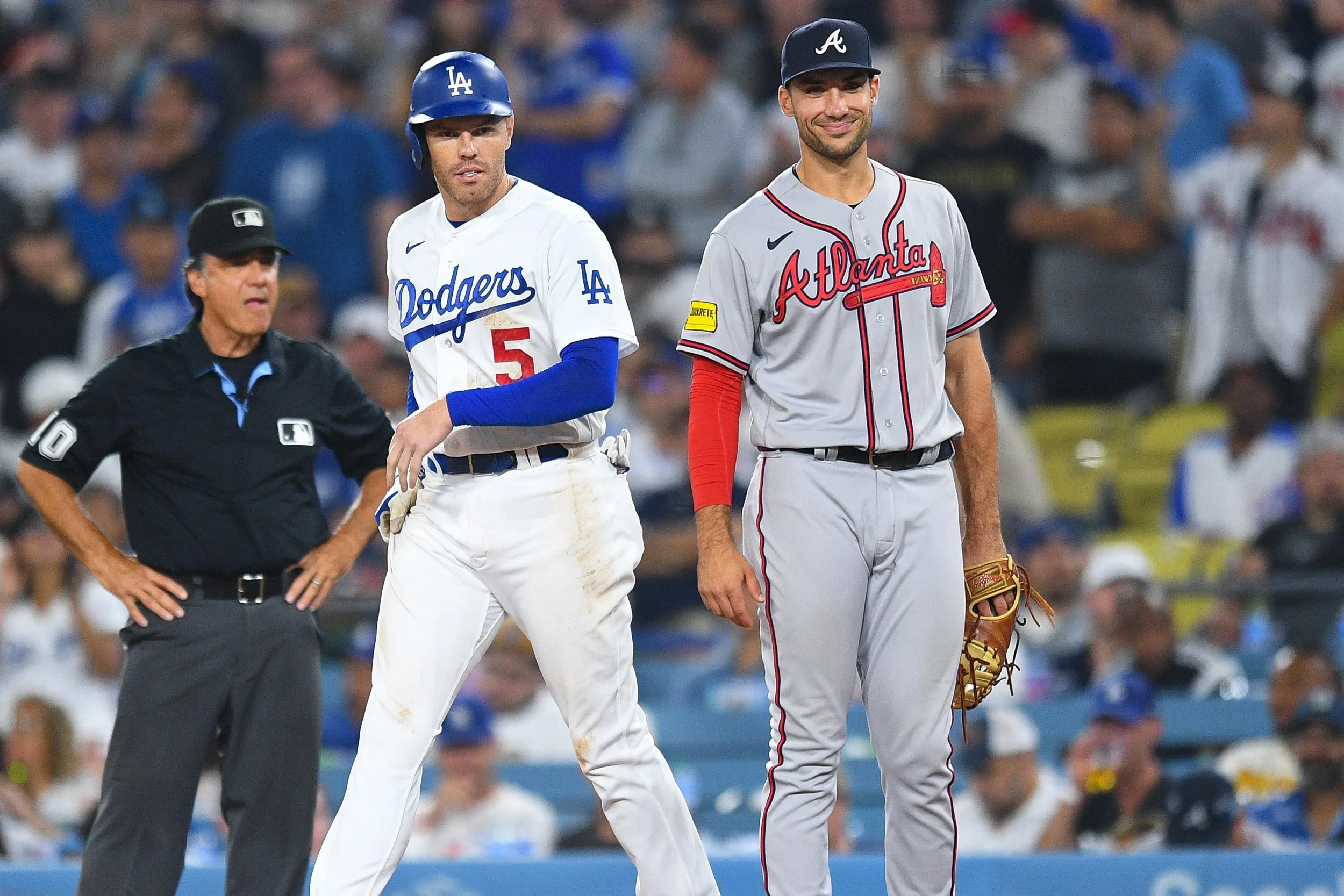
The calendar still says August, but the stakes surrounding the Los Angeles Dodgers' three-game series against the Atlanta Braves have an unmistakable October feel.
Los Angeles arrives at Truist Park riding a six-game winning streak and holding one of the National League's two coveted first-round-bye positions. Atlanta enters as the leader of the NL East but currently sits behind Los Angeles in the race among division winners.
That makes this more than another late-summer matchup between two of the National League's most recognizable contenders.
The Dodgers and Braves are playing for wins that could influence postseason seeding, determine a potentially critical head-to-head tiebreaker and ultimately help decide which club gets to skip the Wild Card Series altogether.
As of Tuesday, the Milwaukee Brewers lead the National League at 81-50, followed by the Dodgers at 80-51 and Braves at 76-55 among the three division leaders. Under MLB's current postseason format, only the top two seeds in each league receive first-round byes.
If the season ended with those positions intact, Milwaukee and Los Angeles would advance directly to the Division Series.
Atlanta would not.
That is why three games in late August could carry consequences that are still being felt in October.
Dodgers Have Put Themselves Back in a Strong Position
The Dodgers could not have entered this series with much more momentum.
Los Angeles has won six consecutive games, matching its longest winning streak of the season. The Dodgers swept both the Colorado Rockies and Pittsburgh Pirates during the run and became the second Major League team to reach 80 victories.
The streak has been particularly important because of what came immediately before it.
Los Angeles had dropped 11 of 16 games before finding its footing, a stretch that temporarily interrupted what had otherwise been one of baseball's strongest seasons. The Dodgers have since responded with cleaner defense, better starting pitching and more consistent offensive execution.
Manager Dave Roberts specifically pointed to improvements in defense, baserunning and overall execution following Sunday's 4-0 victory over Pittsburgh.
Now comes a considerably more revealing test.
Colorado and Pittsburgh gave the Dodgers an opportunity to regain momentum. Atlanta represents an opportunity to turn that momentum into something with direct postseason value.
The Dodgers begin the series with a comfortable 9 1/2-game advantage in the NL West. Atlanta's situation is less secure, with the Braves holding a 3 1/2-game advantage over the Philadelphia Phillies in the NL East entering the series.
That means both teams have divisional considerations, but the larger focus this week extends beyond simply staying in first place.
It is about where those division championships could place them on the postseason bracket.
Why the First-Round Bye Matters So Much
Major League Baseball's playoff format makes finishing among the top two division winners especially valuable.
Six teams from each league qualify for the postseason. The three division champions are seeded Nos. 1 through 3, while the three Wild Card teams receive seeds Nos. 4 through 6.
The top two seeds receive byes directly into the Division Series.
The No. 3 seed does not.
Instead, the third division winner must play a best-of-three Wild Card Series against the No. 6 seed. The Nos. 4 and 5 seeds face one another in the other Wild Card matchup.
There is no mystery about which path a contender would prefer.
A bye eliminates an entire postseason round, provides additional rest for pitchers and allows a team to set its rotation before the Division Series. A team forced into the Wild Card round must immediately survive a short series in which one poor start, one bullpen mistake or one cold offensive night can threaten an entire season.
There are legitimate debates about whether several days without games can disrupt a team's rhythm, but the fundamental advantage is obvious: a club with a bye cannot be eliminated in the Wild Card Series.
For a Dodgers team constructing a potentially imposing October rotation, the ability to skip that round could be particularly valuable.
Tyler Glasnow is returning to the rotation Tuesday. Blake Snell has been outstanding since coming back from injury. Yoshinobu Yamamoto remains a major piece of the staff, while Los Angeles continues building toward additional pitching options as the postseason approaches.
Avoiding a Wild Card Series would give Roberts more control over how those arms are arranged for October.
Atlanta wants exactly the same luxury.
The Dodgers Currently Have the Position Atlanta Wants
The National League's three division leaders enter Tuesday separated into clearly defined positions.
Milwaukee sits first at 81-50.
Los Angeles is one game behind the Brewers at 80-51.
Atlanta is four games behind Los Angeles at 76-55.
The Dodgers therefore have two different races happening simultaneously.
They are trying to catch Milwaukee for the National League's No. 1 seed while also protecting their advantage over Atlanta for a first-round bye.
Winning this series would help with the second objective regardless of what Milwaukee does.
For the Braves, the math makes the head-to-head opportunity especially valuable. Atlanta cannot pass Los Angeles during these three games alone, even with a sweep, but it can dramatically reduce the deficit while simultaneously adding losses to the Dodgers' record.
That is the unique value of playing the team directly ahead of you.
A Braves victory is not simply another win for Atlanta. It is also a Dodgers loss.
Conversely, every Los Angeles victory makes Atlanta's climb substantially more difficult.
A Dodgers sweep would create enormous separation between the clubs entering September. An Atlanta sweep would suddenly make the battle for the No. 2 seed considerably tighter.
That swing is why MLB itself has highlighted the series as one with postseason-seeding implications.
The Season-Series Tiebreaker Could Become Huge
There is another layer to this matchup that could become extremely important if Los Angeles and Atlanta finish with identical regular-season records.
The head-to-head tiebreaker is still undecided.
Atlanta won two of three games when the clubs met at Dodger Stadium in May. Los Angeles won the opener 3-1 before the Braves responded with consecutive 7-2 victories to take the series.
That gives Atlanta a 2-1 advantage entering the final three meetings of the regular season.
The implications are straightforward.
If the Dodgers sweep in Atlanta, they would finish 4-2 against the Braves and secure the head-to-head tiebreaker.
If the Braves win at least two of three, Atlanta would win the season series and own the tiebreaker.
If Los Angeles wins two of three, the season series would finish tied at three games apiece, meaning MLB would move to the next tiebreaker.
Under MLB's system, head-to-head record is the first method used to resolve ties that affect postseason qualification or seeding. If head-to-head records are even, intradivision record is considered next.
That makes these games potentially worth more than their individual place in the standings.
Imagine Los Angeles and Atlanta ending the year with the same record while competing for the second NL bye. A season-series advantage earned in August could determine which team goes directly to the Division Series and which team has to survive a Wild Card matchup.
There is no Game 163 to settle those scenarios anymore.
The mathematical tiebreaker decides it.
Every Dodgers-Braves game this week therefore has the potential to carry an October aftershock.
Home-Field Advantage Is Also Part of the Equation
The bye is the most immediate prize, but postseason seeding affects more than the opening round.
In the Division Series, the higher-seeded team hosts Games 1 and 2 and, if necessary, Game 5 under the 2-2-1 format. The higher seed also receives home-field advantage in a potential League Championship Series matchup.
For the Dodgers, that gives the race with Milwaukee additional significance.
Los Angeles is not merely trying to stay ahead of Atlanta. It remains within striking distance of the Brewers for the National League's top seed.
Finishing No. 1 could matter considerably if Los Angeles advances deep into October.
The same logic applies to Atlanta. The Braves' immediate goal may be climbing into bye position, but every spot gained in the standings can affect where future postseason games are played.
And history has repeatedly demonstrated how small the margins can become in October.
One extra home game may not guarantee anything. Neither does a week of rest. Neither does securing the preferred rotation order.
But contenders spend six months trying to accumulate every possible advantage.
This series offers both clubs an opportunity to secure several of them.
Atlanta Is Trying to Reverse a Difficult Stretch
The two teams also arrive at this matchup heading in opposite directions.
While the Dodgers have won six straight, Atlanta has dropped seven of its past 10 games. The Braves struggled offensively during a recent road trip, averaging just 2.1 runs per game over seven contests.
Several prominent Atlanta hitters have experienced difficult stretches at the same time.
MLB reported that Ronald Acuña Jr. was 6-for-40 over his previous 10 games entering the series, while Matt Olson, Ozzie Albies and Austin Riley were also batting below their customary levels during the Braves' recent slide. Atlanta as a team hit .215 across those 10 games.
That does not make Atlanta an easy opponent.
Far from it.
The Braves remain 21 games above .500 and lead their division. They also demonstrated earlier this year that they can beat the Dodgers in a series, taking two of three in Los Angeles in May.
Atlanta is also returning home with an opportunity to stop its recent skid against the exact club it is chasing for postseason position.
That should make Truist Park an especially difficult environment for a Dodgers team that has largely cruised during its six-game winning streak.
The Pitching Matchups Give the Series an October Flavor
The scheduled starting pitching adds another layer of intrigue.
Tuesday's opener features Tyler Glasnow making his return from the injured list against Bryce Elder.
Wednesday is scheduled to match Roki Sasaki against AJ Smith-Shawver.
Thursday's finale features Yoshinobu Yamamoto against veteran Braves left-hander Chris Sale.
For Los Angeles, the series also begins an important period of evaluating what its rotation could look like in October.
Glasnow's return gives the Dodgers another premium arm. Sasaki remains part of that postseason calculation. Yamamoto has already established himself as one of the club's most important starters.
The Braves, meanwhile, have a chance to test that pitching depth with a lineup capable of producing significant damage when it is right.
That is another reason these games provide more information than a typical August series.
The standings are important, but so is seeing how each contender responds when facing another club it could realistically encounter again in October.
The Dodgers' Offense Faces an Important Test
Los Angeles' six-game streak has coincided with improved overall play, but the offense has not been without concerns.
The Dodgers rank among Major League Baseball's highest-scoring teams, yet inconsistency has periodically created a boom-or-bust feel to the lineup. The situation became more complicated when Andy Pages suffered a fracture in his left hand, an injury expected to sideline one of Los Angeles' more productive run producers for an extended stretch.
That places additional pressure on several established hitters.
Mookie Betts, Freddie Freeman, Shohei Ohtani, Kyle Tucker, Teoscar Hernández and Max Muncy give Los Angeles more than enough offensive talent to withstand an injury, but the Dodgers will need production throughout the lineup against Atlanta's pitching.
The Braves saw firsthand how dangerous this offense can be during the May opener, when Freeman hit his 100th home run as a Dodger against his former club in Los Angeles' 3-1 victory.
Atlanta then demonstrated the opposite side of that matchup by holding the Dodgers to two runs in each of the final two games.
That earlier series offers another reminder of how quickly momentum can change between elite teams.
This Is the Kind of Series the Dodgers Should Want
The Dodgers have reached the point of the season when simply accumulating victories is no longer the only objective.
They need games that prepare them for what comes next.
Atlanta provides exactly that.
The Braves are a division leader with legitimate postseason ambitions. The crowd will be engaged. Every loss carries measurable consequences in the seeding race. Every matchup offers information that could become useful if the clubs meet again in October.
That does not make Tuesday a playoff game.
It does make this considerably more meaningful than an ordinary series in late August.
Los Angeles has built a comfortable cushion in the NL West. The larger challenge now is converting that divisional advantage into the most favorable postseason position possible.
A first-round bye is within the Dodgers' control.
The National League's No. 1 seed remains within reach.
And the head-to-head tiebreaker with one of the league's strongest contenders will be decided over the next three games.
Three Games Could Matter Months From Now
There are still more than 30 games left in the regular season, meaning no one should pretend this series alone will determine the National League playoff bracket.
Milwaukee will have plenty to say about the race for the No. 1 seed.
Philadelphia remains close enough to Atlanta to keep pressure on the NL East.
Injuries, hot streaks, slumps and September schedules will continue reshaping the standings.
But that does not diminish what is at stake in Atlanta.
The Dodgers enter the series with the position the Braves want.
Los Angeles currently owns a first-round bye. Atlanta currently does not.
The Braves hold the advantage in the season series. The Dodgers have one final opportunity to change that.
And with Los Angeles riding six consecutive wins while Atlanta searches for a response after a difficult stretch, the timing gives the matchup an additional edge.
A month from now, these clubs may look back at this series as just another stop during a 162-game schedule.
Or they could look back and identify it as the moment a first-round bye, postseason tiebreaker or home-field advantage changed hands.
That is what makes Dodgers-Braves different this week.
October has not arrived yet, but for three games in Atlanta, the consequences of October already have.