
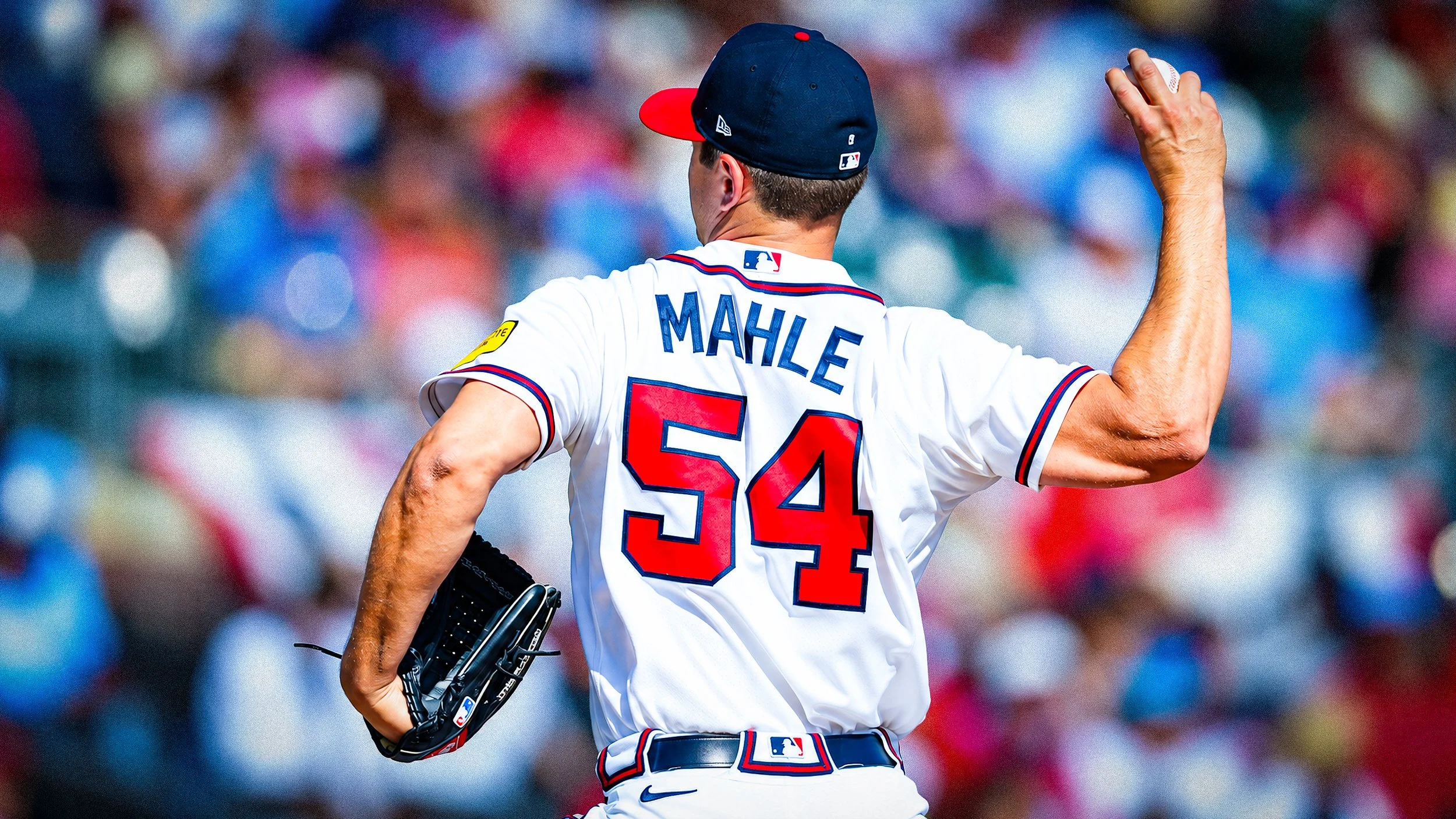
Tyler Mahle’s season can be divided into two dramatically different chapters.
The Dodgers hope Game 4 does not resemble the second one.
Mahle struggled through 18 starts with San Francisco, posting a 5.13 ERA before being traded to Atlanta in August. He then delivered a 1.99 ERA across nine starts for the Braves, turning what initially appeared to be a depth acquisition into one of baseball’s most successful deadline moves.
Now Atlanta will hand Mahle the ball with its season on the line and the Dodgers one victory away from advancing to the National League Championship Series.
The question is not whether Mahle has pitched well recently. He clearly has.
The question is whether his Atlanta performance represents a sustainable change—or the best nine-start stretch of an otherwise inconsistent career.
Mahle’s Improved Control Changed His Season
The clearest difference between Mahle’s stops in San Francisco and Atlanta was his ability to avoid free passes.
Mahle walked 37 batters across 94⅔ innings with the Giants, producing a 3.5 walks-per-nine rate. After joining the Braves, he issued only nine walks over 54⅓ innings, lowering that rate to 1.5 per nine.
His strikeout-to-walk ratio jumped from 2.4 with San Francisco to 5.3 with Atlanta.
That is not a minor change.
Mahle began attacking the zone more consistently and leaned more heavily on his four-seam fastball and splitter while reducing his cutter usage. That simplified approach helped him generate 48 strikeouts against only nine walks for Atlanta.
The results followed:
4–1 record
1.99 ERA
0.96 WHIP
48 strikeouts
Nine walks
54⅓ innings
Mahle’s Atlanta performance was legitimately strong. It should not be dismissed simply because it came across nine starts.
Underlying Numbers Suggest Some Regression Was Possible
Mahle’s 1.99 ERA was considerably lower than his 3.32 FIP with Atlanta.
FIP estimates a pitcher’s performance using outcomes he controls most directly—strikeouts, walks, hit batters and home runs—while removing much of the influence of defense and batted-ball luck.
A 3.32 FIP is still very good. It simply suggests Mahle may not have pitched quite as dominantly as his sub-2.00 ERA indicated.
A similar gap appeared during his successful 2025 season with Texas.
Mahle recorded a 2.18 ERA over 86⅔ innings for the Rangers, but his 3.36 FIP pointed toward strong rather than elite underlying performance. His season was also limited to 16 starts because of a shoulder injury.
Across his full Major League career, Mahle owns an ERA slightly above 4.00. His best full season came with Cincinnati in 2021, when he posted a 3.75 ERA across 33 starts.
That broader résumé matters.
Mahle has shown that he can pitch at a high level, but he has not consistently sustained the results he produced during his final two months with Atlanta.
Mahle Has Already Shut Down The Dodgers This Season
The Dodgers do not need to look far for evidence of what Mahle can do when his command is working.
Pitching for San Francisco on April 22, Mahle held Los Angeles scoreless over seven innings. He allowed three hits and two walks while striking out five as the Giants won 3–0.
That performance came during the same San Francisco stretch in which he finished with a 5.13 ERA.
In other words, even the less consistent version of Mahle was capable of shutting down this Dodgers lineup on the right night.
He also handled his first postseason assignment exceptionally well.
Mahle limited Philadelphia to one run across seven innings in Game 2 of the Wild Card Series, allowing six hits and one walk while striking out six. He completed that outing despite experiencing an abdominal issue during his pregame warmup.
It remains the only postseason appearance of his career, but it showed that the moment did not overwhelm him.
Dodgers Must Force Mahle Into The Strike Zone
Mahle’s turnaround was built largely on throwing more strikes and limiting unnecessary traffic.
That makes the Dodgers’ approach relatively clear.
They need to avoid chasing his splitter below the zone, extend at-bats and force him to bring pitches into hittable areas. Freddie Freeman specifically pointed toward laying off pitches down and waiting for Mahle to make a mistake.
That approach worked against Chris Sale in Game 3. The Dodgers elevated Sale’s pitch count, created traffic and eventually broke through with home runs from Kiké Hernández and Freeman.
Mahle may not possess Sale’s résumé, but his recent results demand the same level of discipline.
Recent Form Deserves Respect—But Not Fear
The Dodgers are not facing the same pitcher who produced a 5.13 ERA with the Giants.
Mahle improved his command, adjusted his pitch usage and carried those changes into an excellent postseason debut.
But Los Angeles is also not facing a pitcher with a long record of ace-level production.
Mahle finished the regular season with a 3.99 ERA and 4.17 FIP across his combined work with San Francisco and Atlanta. Those numbers provide a more complete picture than either his struggles with the Giants or his dominant stretch with the Braves alone.
His recent form makes him a legitimate obstacle.
His career record leaves reason to believe the Dodgers can break through if they remain patient and force him away from the low part of the zone.
Mahle has been a different pitcher since joining Atlanta. Game 4 will reveal whether that transformation can survive a Dodgers lineup trying to end the Braves’ season.