
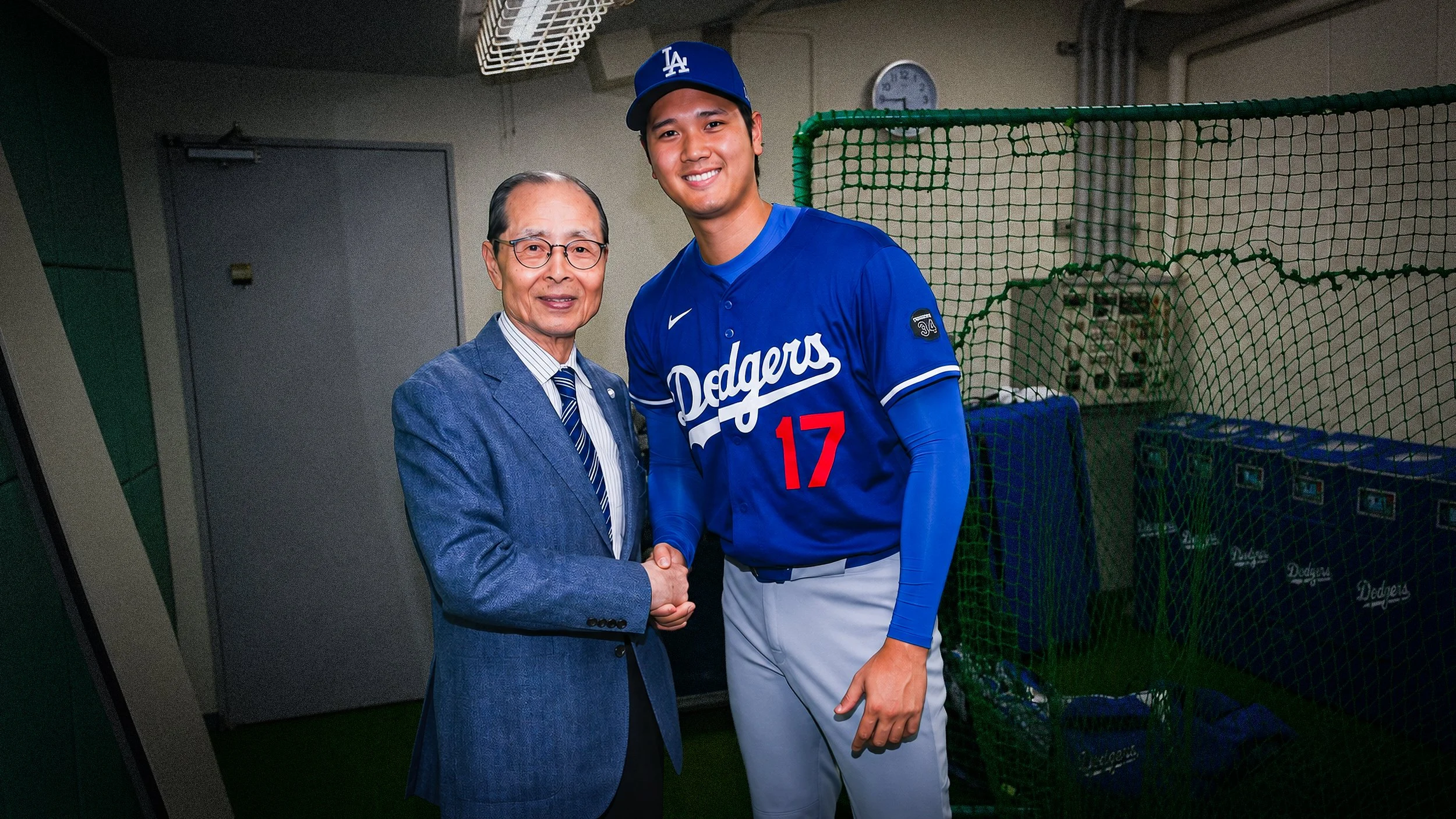
One of the greatest home run hitters in baseball history believes Shohei Ohtani should consider putting down the baseball and concentrating exclusively on the bat.
Sadaharu Oh shared that opinion during a Friday press conference in Tokyo, questioning whether Ohtani can continue maintaining an elite two-way workload as he moves deeper into his career.
“Personally I think it’s only natural that he might not be able to maintain that same level year after year,” Oh said, according to an AFP report on the Tokyo press conference.
Oh said he would be interested to see how far Ohtani could take his offensive production if he focused entirely on hitting.
That should not be mistaken for a Dodgers decision.
Andrew Friedman has said Los Angeles fully expects Ohtani to pitch in 2027. Ohtani has also confirmed that he intends to continue as a two-way player.
The unresolved question is not whether the Dodgers currently want him to pitch.
It is how they can keep him healthy enough to contribute on both sides through October.
Oh Believes The Two-Way Workload May Become Unsustainable
Oh’s opinion carries significant weight in Japan.
He hit 868 home runs during his career with the Yomiuri Giants and remains one of the most influential figures in Japanese baseball. He understands the physical and mental demands required to produce elite offense over an extended period.
Oh’s concern is that Ohtani’s pitching ability and durability may naturally decline with age, making it increasingly difficult to maintain the unprecedented standard he has created.
Ohtani turns 33 next July.
He also spent much of the second half of 2026 managing problems with his left knee and right biceps. Those injuries eventually affected both parts of his game.
Ohtani made his final pitching appearance on July 3. He later attempted to resume a throwing progression, but the additional work coincided with a significant offensive decline.
Beginning August 8, when Ohtani restarted his throwing program, he hit .205 with a .666 OPS over his final 29 regular-season games.
That overlap strengthens Oh’s argument.
Pitching preparation does not occur only once every five or six days. It requires bullpen sessions, recovery work, treatment and continuous mechanical maintenance. Every part of that routine creates another demand on Ohtani’s body while he also prepares to hit every day.
Concentrating only on offense could allow Ohtani to dedicate more of his recovery and training toward remaining an elite hitter.
Ohtani Still Produced At An Elite Level On The Mound
The strongest argument against abandoning Ohtani’s two-way role is simple: He remained one of baseball’s best pitchers when healthy.
Ohtani finished 2026 with an 8–2 record, 1.79 ERA, 0.95 WHIP and 95 strikeouts across 85⅔ innings. Opponents batted only .180 against him.
Through his first 10 starts, Ohtani recorded a 0.74 ERA.
His production declined over his final four appearances while he was already dealing with knee discomfort, but the complete performance still demonstrated why the Dodgers are reluctant to remove pitching from his future.
A healthy Ohtani is not merely a designated hitter who can occasionally provide a few innings.
He is a legitimate top-of-the-rotation starter.
That creates extraordinary roster value. Ohtani can occupy one lineup spot while contributing as one of the club’s best pitchers, allowing the Dodgers to construct their roster in ways no other team can easily duplicate.
Choosing to end that part of his career following one injury-affected season would be premature.
His Offensive Decline Still Cannot Be Ignored
Ohtani’s 2026 offensive numbers would represent an excellent season for most players.
He batted .275/.377/.512 with 30 home runs, 81 RBIs and an .889 OPS across 135 games. He led the Dodgers in home runs and remained one of their most productive hitters.
They were also his lowest home run and OPS totals since joining Los Angeles.
Ohtani hit 54 home runs in 2024 and 55 in 2025 before dropping to 30 this season. His injuries contributed to that decline and left him looking noticeably compromised during the final weeks.
He then batted .192 with one extra-base hit during the postseason.
Ohtani refused to blame his physical condition for those struggles, but the Dodgers cannot ignore how the injuries and attempted pitching comeback affected his swing.
The problem was not simply that Ohtani became injured.
It was that the knee, biceps, throwing progression and everyday hitting responsibilities repeatedly interacted with one another.
Oh’s recommendation addresses that problem in the most direct way possible: remove pitching entirely.
The Dodgers appear interested in finding a less drastic solution.
Dodgers Still Expect Ohtani To Pitch In 2027
Friedman said in October that surgery was not being considered for Ohtani’s knee or biceps.
He also made the organization’s pitching expectation clear.
“I fully expect him to pitch next year,” Friedman said.
As we previously covered in our report on Ohtani’s offseason medical outlook, that statement did not guarantee an Opening Day start or establish a projected number of innings.
Friedman acknowledged that Los Angeles must reconsider how it combines Ohtani’s pitching and hitting responsibilities.
The Dodgers could delay his return to the rotation, build additional rest into his schedule, skip selected starts or separate his pitching days from his work as a hitter.
Friedman even raised the possibility that Ohtani might not begin the season in the rotation despite being healthy enough to pitch.
No plan has been announced.
What has been established is that the Dodgers are not currently following Oh’s recommendation.
Hideki Kuriyama Believes Ohtani Will Respond
Hideki Kuriyama offered a more optimistic assessment during the same press conference.
Kuriyama coached Ohtani with the Nippon-Ham Fighters and later led Japan to the 2023 World Baseball Classic championship. He has played an important role in Ohtani’s development as a two-way player.
Rather than suggesting Ohtani narrow his focus, Kuriyama believes the disappointment and injuries of 2026 could motivate another breakthrough.
He predicted that Ohtani would return and surprise everyone again next season, believing that the setbacks could become an opportunity for further growth.
The differing perspectives are understandable.
Oh looks at the physical demands and wonders how much more Ohtani could accomplish offensively without pitching.
Kuriyama looks at Ohtani’s history of overcoming limitations and sees another challenge he may solve.
Both perspectives recognize that 2026 cannot simply be ignored.
The Answer May Be A Reduced Two-Way Role
Our take: The Dodgers should not ask Ohtani to stop pitching—but they should stop treating every available start and plate appearance as something they must use.
His 1.79 ERA demonstrates that the pitching value remains too significant to abandon.
His second-half decline demonstrates that the workload needs to change.
The most reasonable path is preserving Ohtani’s two-way role while becoming considerably more aggressive about rest. That could include:
Delaying his first pitching start
Using a six-man rotation
Skipping starts during difficult stretches of the schedule
Giving him complete days away from both roles
Reducing or eliminating hitting duties on selected pitching days
Ending a throwing progression immediately if it begins affecting his swing
The objective should not be maximizing Ohtani’s regular-season workload.
It should be having the healthiest possible version of him available in October.
Oh’s suggestion is not unreasonable. If Ohtani’s pitching preparation continues compromising his bat—or if the injuries become increasingly difficult to manage—the Dodgers may eventually need to reconsider whether the two-way experiment remains sustainable.
They are not at that point yet.
Ohtani still believes he can do both.
The Dodgers still believe he can do both.
His performance on the mound gives them a compelling reason to try again—with a better plan.
Should the Dodgers continue using Ohtani as a regular starting pitcher, reduce his pitching workload or ask him to focus entirely on hitting?