
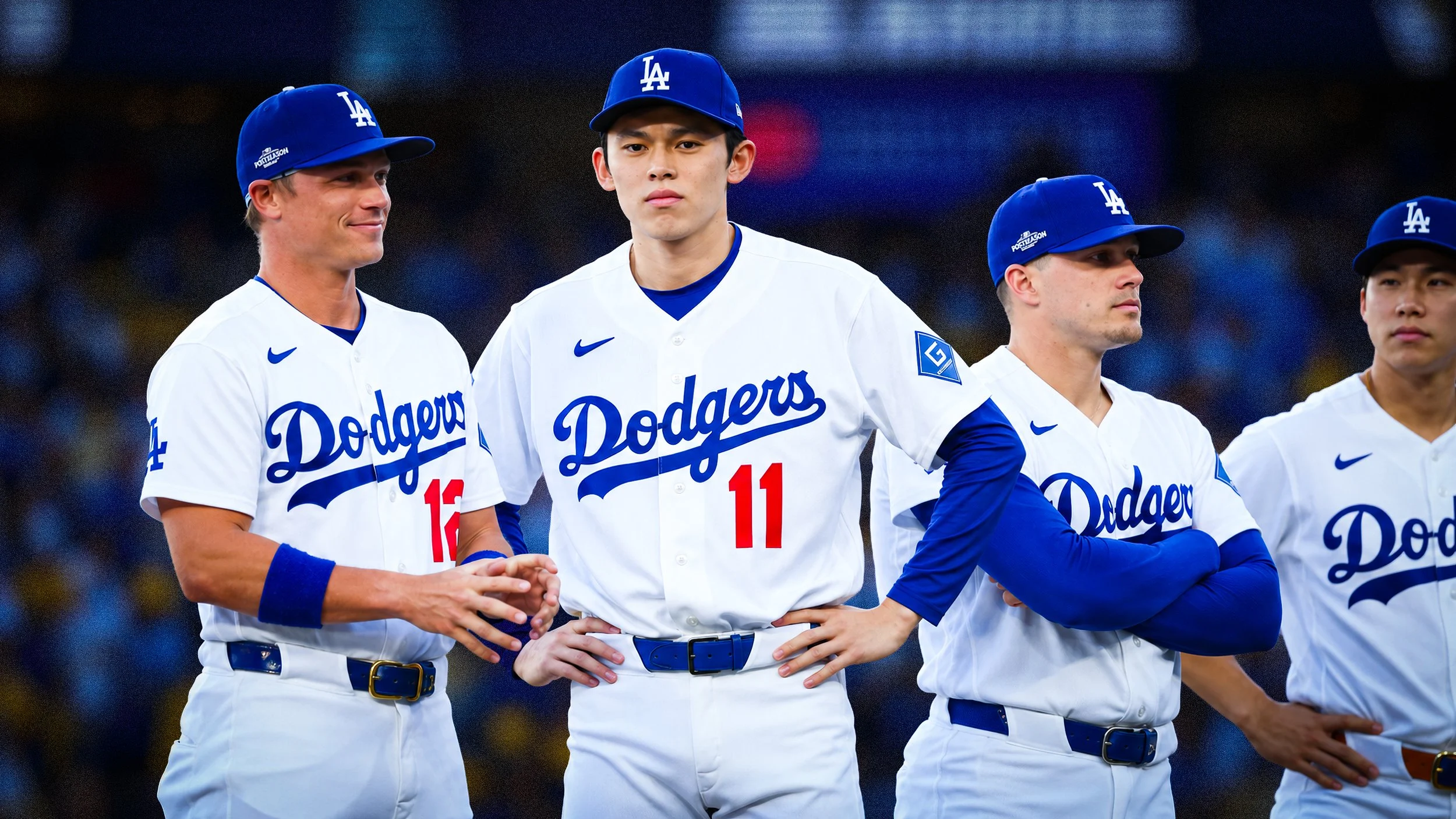
Roki Sasaki does not want to spend another October waiting for an opportunity out of the Dodgers’ bullpen.
He wants to earn a place in the postseason rotation.
In an October 27 report by Dylan Hernández, Sasaki explained that his goal is to produce throughout the regular season at a level that leaves the Dodgers with no reason to move him out of their rotation when the postseason begins.
“I know what I did this year wasn’t enough,” Sasaki said. “There are a lot of good pitchers on the team.”
That is not a complaint about how the Dodgers used him.
Sasaki acknowledged that winning must come before individual preference in October. His position is simple: If he wants to start postseason games, he must pitch well enough during the regular season to deserve them.
His six-start run following the All-Star break showed that possibility exists.
Turning those six starts into a full season is now the challenge.
Sasaki’s 2026 Season Contained Two Very Different Halves
Sasaki entered the All-Star break with a 5.33 ERA and 1.36 WHIP across 81 innings.
His command remained inconsistent, and his fastball did not always produce results matching its velocity. The Dodgers continued giving him opportunities, but he had not established himself as one of their most dependable starters.
Then something changed.
From July 17 through August 19, Sasaki went 2-0 with a 2.31 ERA and 34 strikeouts over 35 innings across six starts. He averaged nearly six innings per appearance and began resembling the pitcher the Dodgers believed they were acquiring from Japan.
A blister on his right middle finger interrupted that progress.
Sasaki attempted to pitch through the problem against Atlanta on August 26, but the skin tore during the fourth inning and began affecting his slider. He was charged with four runs before leaving and subsequently spent nearly a month on the injured list.
He returned during the final week of the regular season and made three scoreless one-inning appearances out of the bullpen.
Sasaki then allowed one run across 3⅓ postseason innings. He finished October with a 2.70 ERA, but the Dodgers never used him as a starter.
His Overall Numbers Show Why The Job Was Not His
Sasaki finished the regular season 5-5 with a 4.49 ERA, 1.32 WHIP and 123 strikeouts over 122⅓ innings.
Those numbers represented meaningful progress from his injury-shortened rookie season.
A shoulder impingement limited Sasaki to 36⅓ Major League innings in 2025. He posted a 4.46 ERA with 28 strikeouts and 22 walks before returning as a reliever and becoming an important part of the Dodgers’ championship bullpen.
Sasaki recorded three postseason saves in 2025 and allowed only one run over 10⅔ innings. That performance proved he could succeed against playoff lineups in short bursts.
It did not establish that he could consistently navigate those lineups two or three times as a starter.
His 2026 workload provided more evidence. Sasaki made 23 starts and improved his strikeout and walk rates, but the 4.49 ERA illustrates why the Dodgers trusted other options with their most important postseason starts.
His encouraging second half deserves attention.
So does the inconsistent first half that preceded it.
The Talent Has Never Been The Question
Sasaki arrived in the United States with one of the most impressive pitching résumés ever produced by a player his age in Japan.
He posted a 2.10 ERA during his Nippon Professional Baseball career. His most famous performance came in 2022, when he threw a perfect game with 19 strikeouts and set an NPB record by striking out 13 consecutive hitters.
His combination of upper-90s velocity and a devastating split-finger pitch created expectations that he could eventually become a frontline Major League starter.
Sasaki’s ambitions remain just as high.
Hernández reported that Sasaki wants to produce strong regular-season numbers and compete for individual honors. Andrew Friedman previously revealed that one of Sasaki’s goals is to become the first Japanese pitcher to win a Cy Young Award.
That remains a distant objective based on his first two Major League seasons.
But his second-half improvement offered the first extended look at how he could begin moving toward it.
The Harder Splitter Helped Change His Season
One of Sasaki’s most important developments was separating his original forkball into two distinct pitches.
The original forkball sits in the mid-80s and features extremely low spin with unpredictable movement. That unpredictability can make the pitch difficult for hitters—but also difficult for Sasaki to command.
He added a harder splitter that operated closer to 90 mph and moved more consistently.
The difference mattered.
Hitters batted only .161 with a .224 weighted on-base average against Sasaki’s splitter during the 2026 season. The pitch generated a 36.5 percent whiff rate and became the most reliable weapon in his arsenal.
Brandon Gomes specifically identified Sasaki’s adjustment with the split-finger pitch as a turning point in his season.
The next step is repeating that pitch consistently over 30 starts rather than six.
Sasaki cannot rely on one unhittable secondary offering if he struggles to locate it or falls behind in counts.
His Fastball Must Become More Than A Velocity Number
Sasaki’s fastball velocity improved considerably.
He averaged approximately 97.9 mph in 2026 after sitting closer to 96.1 mph during his rookie season. Sasaki also told Hernández that his velocity returned near the end of the year.
That is encouraging, but velocity alone did not make the pitch effective.
Hitters batted .321 and slugged .584 against his four-seam fastball. The pitch allowed a .432 weighted on-base average and a 56.4 percent hard-hit rate.
Those are not the results of a dependable foundational pitch.
Sasaki must improve either its movement, location or how he sequences it with his secondary pitches. Major League hitters can handle 98 mph when they know where it is going and when it is coming.
The fastball does not need to become his best pitch.
It needs to become credible enough that hitters cannot sit on the splitter or wait for a mistake.
The Slider Could Determine His Future As A Starter
The slider produced more encouraging underlying numbers.
It generated a 39.5 percent whiff rate, and hitters managed a .218 average against it. Its expected statistics were also considerably better than the actual damage Sasaki allowed.
Sasaki acknowledged that his breaking pitches have not yet reached the level he wants.
That may be the most important part of his offseason.
A starter generally needs more than a fastball and one elite putaway pitch. The ability to land a slider for a strike, expand it below the zone and use it against both right-handed and left-handed hitters would give Sasaki another option during his second and third trips through a lineup.
His splitter can dominate individual plate appearances.
A dependable slider could help him dominate entire starts.
Better Command Must Accompany The New Pitches
Sasaki reduced his walk rate from 13.7 percent as a rookie to approximately 9.2 percent in 2026.
That was meaningful improvement, but it still left him with 48 walks across 122⅓ innings.
The Dodgers need him to work ahead more consistently, avoid unnecessary deep counts and give himself a chance to pitch beyond the fifth inning.
His six-start stretch demonstrated what happens when those pieces come together.
Sasaki reached at least five innings in each appearance and completed six innings four times. That allowed his talent to affect more of the game and reduced the burden on the bullpen.
One dominant inning at a time made him a dangerous postseason reliever.
Five or six well-controlled innings every fifth or sixth day would make him a trusted postseason starter.
October Will Be Earned During The Summer
Sasaki has now spent two consecutive postseasons in the Dodgers’ bullpen.
He succeeded there, especially during the 2025 championship run, but that does not mean relief work represents his permanent future.
It also does not guarantee the Dodgers will simply place him in their 2027 rotation and leave him there.
Sasaki must prove that the improved splitter, restored velocity and better command can survive a complete season. He also must remain available after injuries disrupted both of his first two Major League campaigns.
The blister was not evidence that Sasaki cannot handle a starting workload. Blisters can happen to any pitcher, especially one who relies heavily on split-finger grips.
Availability will still be part of the evaluation.
The Dodgers will want to see whether he can make 25 or more starts, carry his best pitches deep into games and respond when opponents adjust.
Sasaki does not need the Dodgers to declare him an October starter in November. He needs to make the decision unavoidable by becoming the same pitcher from April through September that he briefly became after the All-Star break.
What is the biggest key for Sasaki in 2027: fastball command, developing the slider or staying healthy for a complete season?