
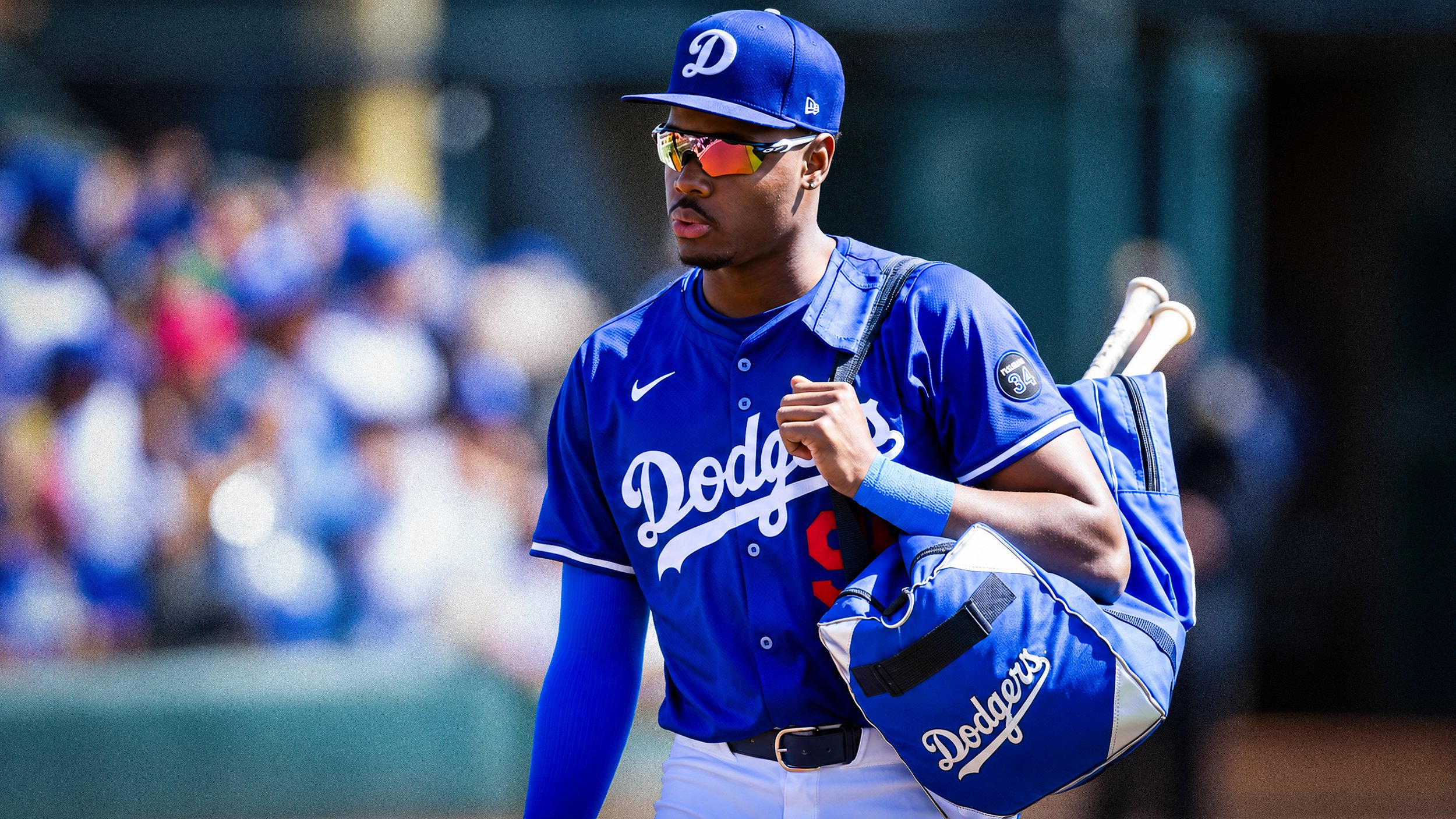
Josue De Paula did enough with his bat during his first Major League opportunity to leave Dodgers fans wanting more.
Now he must prove that his glove can keep him in the lineup.
Brandon Gomes identified De Paula’s outfield defense as one of the organization’s priorities for him this offseason. The Dodgers believe he possesses the physical ability to improve, but becoming a dependable defender could determine how quickly he moves from an exciting young bat to an everyday Major League player.
“We’ve talked through it,” Gomes said Wednesday. “His mindset, and our coaching staff and all of us is, to make him as good a defensive outfielder as possible.”
That statement does not guarantee De Paula a starting job in 2027.
It does, however, make his developmental assignment clear.
De Paula’s Bat Already Looks Ready To Help
There was very little about De Paula’s first exposure to Major League pitching that appeared overwhelming.
The 21-year-old hit .323/.500/.581 across 42 plate appearances, collecting 10 hits, 11 walks and only five strikeouts. His first Major League hit was a three-run home run against Miami, and he consistently produced competitive at-bats against significantly more experienced pitchers.
The plate discipline may have been the most encouraging part of his arrival.
De Paula did not simply survive by attacking fastballs and hoping his power carried him. He controlled the strike zone, refused to chase consistently and forced pitchers to come to him.
That approach carried over from a dominant season with Double-A Tulsa, where he hit .303/.401/.547 with 27 home runs, 37 doubles, 104 RBIs, 106 runs and 31 stolen bases. His performance earned him Texas League MVP honors before the Dodgers called him directly to the majors.
Dave Roberts described him as a “special hitter,” and nothing from his brief opportunity changed that evaluation.
The offensive upside is why fans understandably want to see De Paula receive a larger role next season.
The defensive questions explain why that decision is not as simple as looking at his batting line.
Ohtani Makes The Defensive Development Essential
De Paula received most of his initial opportunities at designated hitter while Shohei Ohtani was on the injured list.
That position will not provide a regular path into the lineup when Ohtani is available.
If De Paula is going to play consistently for the Dodgers, he will need to handle one of the corner-outfield positions well enough that the team does not sacrifice too much defensively to keep his bat in the order.
He appeared in the outfield only twice during his 11-game regular-season stint, totaling six innings in left field. The Dodgers also limited him primarily to pinch-hitting opportunities during the postseason.
That usage showed the difference between believing in De Paula’s offensive talent and trusting him as a complete Major League player.
The Dodgers do not need him to become an elite defender immediately. They need him to make reliable reads, take efficient routes and convert the plays an everyday corner outfielder should make.
If he can reach that level, his bat becomes much easier to carry in the lineup every day.
The Defensive Work Has Already Started
This is not a new concern being handed to De Paula after the season.
He spent considerable time working with Dino Ebel during his September call-up, frequently appearing on the field early for defensive drills. Their work included first steps, routes, fly balls, throwing and maintaining focus throughout an entire game.
Ebel also showed De Paula defensive data comparing him with other outfielders, including Andy Pages. That comparison gave De Paula a relevant example of how much a young player can improve through repetition and attention to detail.
Pages developed from a player with defensive questions into someone the Dodgers trusted in center field. De Paula does not need to follow the exact same path, but his teammate provides evidence that defensive evaluations are not permanent.
Jason Heyward also worked with De Paula and praised the young outfielder’s willingness to accept constructive criticism.
That willingness matters.
The raw tools will only help if De Paula commits to the daily work required to improve his reactions, positioning and routes.
A Starting Job Has Not Been Promised
De Paula’s impressive debut should put him firmly in the Dodgers’ 2027 conversation, but the organization has not announced where he will begin the season or how much he will play.
A strong spring could make the decision more interesting. So could meaningful defensive progress over the winter.
But the Dodgers are unlikely to keep one of their best young hitters in the majors merely to sit on the bench. Wherever De Paula opens the season, consistent playing time will remain important to his development.
The question is no longer whether his bat gives him a chance to help the Dodgers.
It clearly does.
The question is whether his defense can become dependable enough for the Dodgers to leave that bat in the lineup.
De Paula Controls The Next Step
De Paula does not need to silence every concern with one offseason.
He needs to show progress.
If his reads improve, his routes become more efficient and the Dodgers trust him to finish games in the outfield, he could give an aging lineup exactly what it needs: a young, disciplined left-handed hitter with power and the ability to reach base.
His bat opened the door during September.
Improving his glove is how De Paula can turn that opportunity into an everyday role with the Dodgers.
How much defensive improvement would you need to see before making De Paula an everyday starter?