
Josue De Paula’s Breakout Start Strengthens Case for Dodgers Postseason Roster
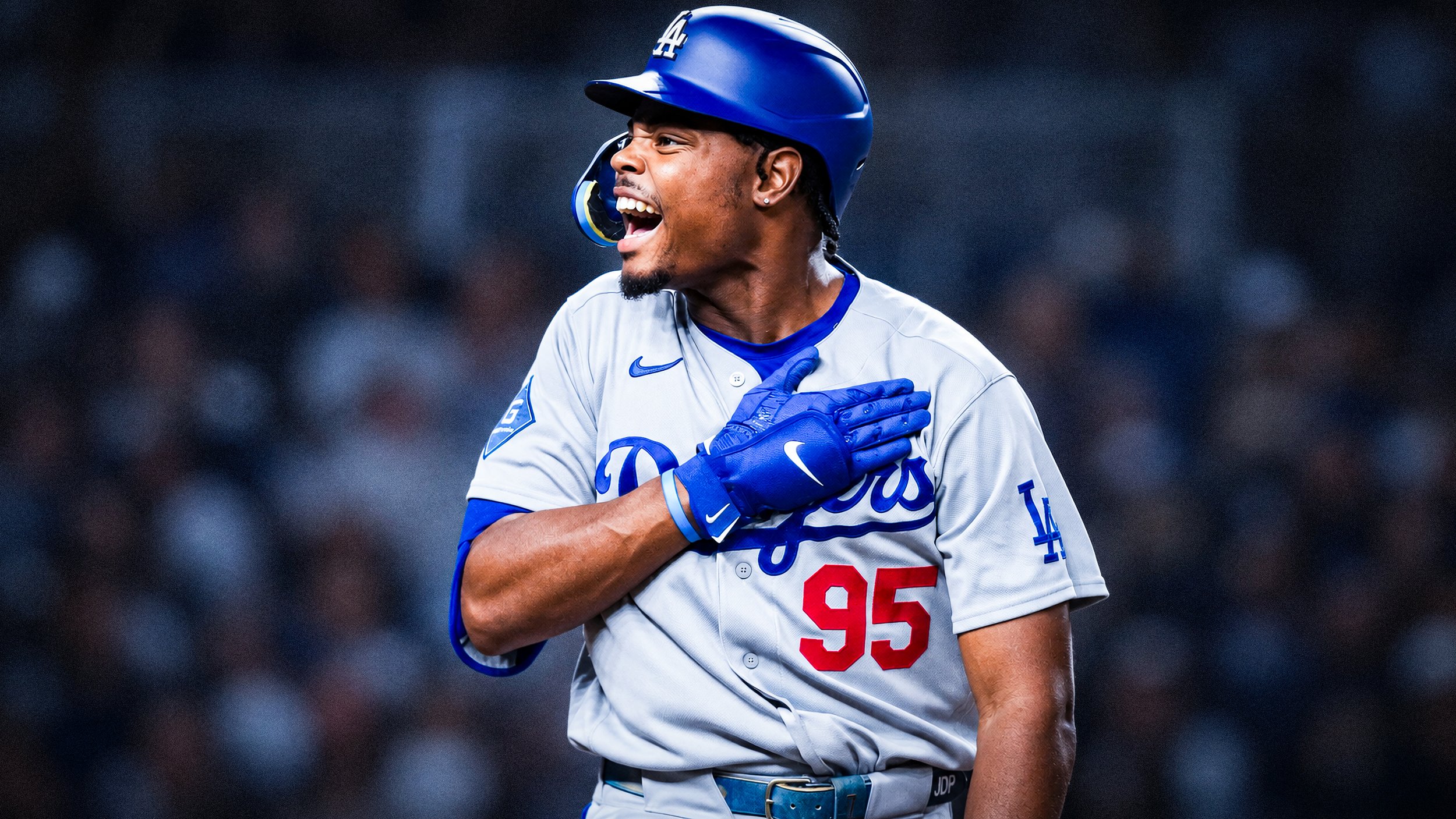
Josue De Paula needed nine plate appearances to record his first Major League hit.
During that wait, the Los Angeles Dodgers’ top prospect showed that he did not need a hit to produce quality at-bats.
De Paula consistently controlled the strike zone, accepted his walks and refused to abandon his approach while searching for his first result. When the breakthrough finally arrived Sunday, he turned it into the biggest offensive performance of his young career.
The 21-year-old launched a three-run home run and followed it with a double during the Dodgers’ 6-4 loss to the Miami Marlins, completing an impressive first weekend in the majors.
Through his first three appearances, De Paula is batting .286 with a .545 on-base percentage, an .857 slugging percentage and a 1.403 OPS.
He has two hits in seven at-bats, including one double and one home run, with three RBIs, two runs scored and four walks across 11 plate appearances. (Baseball Almanac)
The sample is extremely small.
The quality of the plate appearances, however, gives the Dodgers something meaningful to evaluate.
De Paula Shows Patience During MLB Debut
De Paula made his Major League debut Friday after the Dodgers placed Shohei Ohtani on the 15-day injured list and selected De Paula’s contract from Double-A Tulsa.
Batting seventh as the designated hitter, De Paula went 0-for-3 with a walk.
His first Major League plate appearance ended with a flyout to right field. He later worked a full-count walk, struck out in the seventh inning and finished his night by hitting a hard ground ball down the first-base line.
The final box score did not fully reflect the quality of his debut.
Manager Dave Roberts said De Paula did not appear overwhelmed and praised his ability to conduct competitive at-bats. The Dodgers saw him work a walk, make hard contact and remain composed against both right-handed and left-handed pitching.
“That was exciting,” Roberts said. “I thought he was going to conduct good at-bats.”
De Paula also attempted to steal second base after drawing his walk, although he was thrown out as part of a strikeout-throw-out double play.
He did not record a hit, but his combination of patience, aggression and composure immediately gave the Dodgers a glimpse of why the organization was comfortable promoting him directly from Double-A. (MLB.com)
Quality At-Bats Continue in Second Appearance
De Paula returned as the designated hitter Saturday and again went without a hit, finishing 0-for-2.
But he drew two more walks.
His second walk came on four pitches with two outs in the ninth inning and the Dodgers trailing 4-2. De Paula advanced to second on defensive indifference and scored on Hunter Feduccia’s single, bringing Los Angeles within one run before the comeback attempt ended.
Through his first two Major League games, De Paula had gone hitless in five at-bats but reached base three times.
Roberts was particularly encouraged by the pitches De Paula refused to chase.
“I don’t think he swung at a ball out of the hitting zone,” Roberts said after Saturday’s game. (Los Angeles Times)
That discipline mattered because De Paula could have easily become overly aggressive while pursuing his first Major League hit.
Instead, he continued trusting the approach that helped him bat .303/.401/.547 with 27 home runs, 104 RBIs and 81 walks in 124 games for Double-A Tulsa.
The hits had not arrived yet, but De Paula was not giving away plate appearances.
First Major League Hit Leaves the Ballpark
De Paula made his first Major League start in left field Sunday after serving as the designated hitter in his first two games.
He began the afternoon with another disciplined plate appearance, drawing a five-pitch walk in the second inning.
That gave him at least one walk in each of his first three Major League games, something no Dodgers player had accomplished since Mickey Hatcher in 1979. (True Blue LA)
De Paula stepped to the plate again in the fourth inning with Will Smith and Alex Freeland aboard and the game scoreless.
Facing Marlins starter Eury Pérez, De Paula fouled off three sinkers and stayed alive long enough to force Pérez toward another option. The right-hander eventually challenged him with a 98 mph four-seam fastball over the inner portion of the plate.
De Paula turned on it.
The ball left his bat at 108.2 mph, traveled 416 feet and landed in the upper deck beyond the right-field wall.
His first Major League hit was a three-run home run that gave the Dodgers a 3-0 lead.
At 21 years and 112 days old, De Paula became the youngest Los Angeles Dodgers player to homer since Adrián Beltré in 2000.
“I’ll never forget it,” De Paula said. “It was awesome.”
De Paula nearly added another home run in the sixth inning. He drove a splitter from Jack Ralston 385 feet off the wall in right-center field, settling for his first Major League double.
He finished the afternoon 2-for-2 with a home run, double, walk and three RBIs, reaching safely during all three of his plate appearances.
The Dodgers recorded only two other extra-base hits in the game. (Reuters)
De Paula Brings Energy to a Veteran Dodgers Roster
De Paula’s production was only part of what stood out Sunday.
After watching his home run clear the wall, he looked toward the Dodgers’ dugout, slapped the front of his jersey and shouted as his teammates erupted.
It was the type of emotional reaction expected from a 21-year-old who had just turned his first Major League hit into a 416-foot home run.
That energy offers something different to a veteran-heavy Dodgers roster preparing for another postseason run.
De Paula has not looked intimidated by the environment or the pitchers confronting him. His enthusiasm has been accompanied by an unusually calm approach in the batter’s box.
Roberts previously compared De Paula’s demeanor to Will Smith’s and said the organization did not expect the game to speed up on him.
The first three games supported that assessment.
De Paula did not begin chasing pitches when his first hit failed to arrive Friday or Saturday. He continued working counts, drawing walks and trusting that a hittable pitch would eventually come.
“My first two days, I loved my at-bats, even though I didn’t get the results,” De Paula said.
His patience was rewarded Sunday.
Dodgers Are Evaluating More Than the Box Score
The Dodgers promoted De Paula because they believe his offensive approach can compete against Major League pitching.
Before the call-up, Roberts praised his ability to control the strike zone and handle velocity. He also noted that the quality of pure arm talent in Double-A can resemble what hitters encounter at Triple-A.
De Paula’s first weekend offered early support for that confidence.
He drew four walks and struck out only once in 11 plate appearances. He handled a 98 mph fastball from Pérez and produced hard contact without expanding the strike zone to manufacture results.
Those are encouraging signs, but opposing teams will make adjustments.
Pitchers will identify the areas of the strike zone De Paula handles best, test him with different sequences and force him to prove he can adjust in return. Three games cannot establish whether he is ready to help the Dodgers throughout October.
The next two weeks will provide a more meaningful evaluation.
Defense Remains Part of De Paula’s Evaluation
De Paula’s bat is ahead of his defense, and the Dodgers have been direct about that part of his development.
He split time between left and right field with Tulsa but committed eight errors during the season. Roberts has emphasized that De Paula must place greater value on converting defensive opportunities into outs.
The Dodgers started him in left field Sunday but replaced him defensively after his sixth-inning double.
That decision demonstrated the obstacle De Paula still faces.
A powerful left-handed bat could help the Dodgers off the postseason bench, but defensive versatility would make it considerably easier to carry him. If the team views him exclusively as a pinch hitter or designated hitter, his potential role becomes narrower—especially once Ohtani returns.
De Paula has been working with third-base coach Dino Ebel on a pregame defensive routine. How much progress he demonstrates in left and right field could become nearly as important as his offensive production.
His Postseason Eligibility Is Not Automatic
De Paula is not currently eligible for the postseason roster under MLB’s standard rules.
The Dodgers did not add him to their 40-man roster until September 11, meaning he missed the September 1 eligibility deadline.
There is still a potential pathway for him to play in October.
Because De Paula was already in the Dodgers organization before September 1, Los Angeles can petition the Commissioner’s Office to allow him to replace an injured postseason-eligible position player who has served the required minimum time on the injured list.
MLB would need to approve that request. (MLB.com)
Therefore, strong performance alone cannot place De Paula on the postseason roster.
His play would need to convince the Dodgers that he represents their best available replacement option, the necessary injury and roster conditions would need to exist, and MLB would need to approve the move.
That makes his postseason candidacy possible—not automatic.
De Paula Is Giving the Dodgers Something to Consider
When Roberts was asked whether De Paula could potentially earn a postseason role, the Dodgers manager did not dismiss the possibility.
“Anything’s possible,” Roberts said. (MLB.com)
That should not be interpreted as a promise that De Paula will appear in October.
Ohtani is expected to return before the postseason, reducing the available at-bats at designated hitter. The Dodgers could also regain other injured position players, creating additional competition for roster spots.
De Paula must continue proving that his plate discipline and power can hold up as Major League pitchers adjust to him. He must also demonstrate that he can contribute defensively or provide enough offensive value to justify a specialized bench role.
But his first three games have given the Dodgers exactly what they wanted from this opportunity.
They have seen controlled at-bats.
They have seen elite power.
They have seen a young player remain patient without becoming passive.
And they have seen the emotion and energy De Paula can inject into the team.
Three games have not earned him a postseason roster spot.
They have, however, given the Dodgers a reason to seriously evaluate whether he could help them in October.