
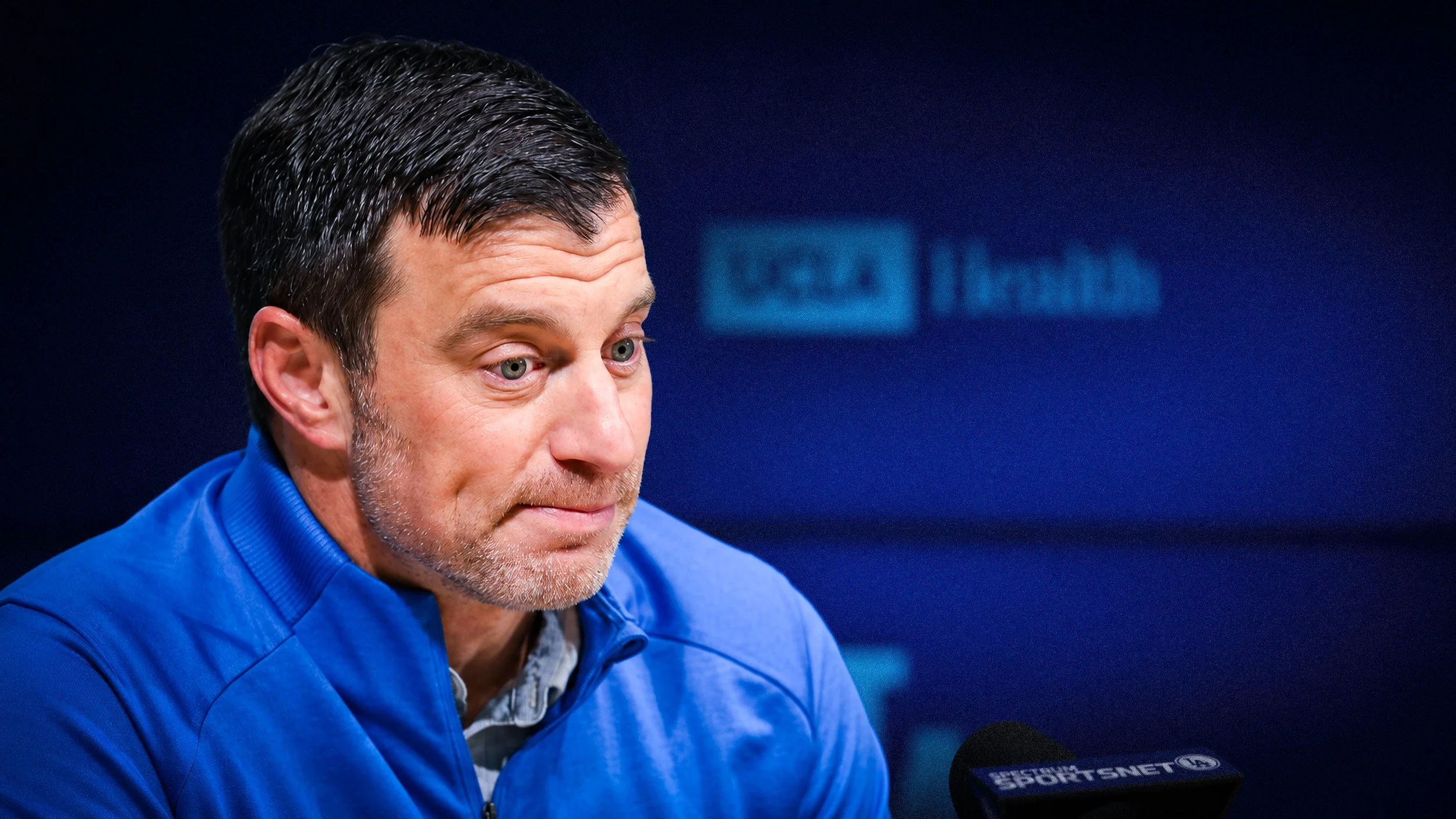
Andrew Friedman is right about the danger of building an offseason plan around one convenient postseason narrative.
The Dodgers did not lose the NLCS because Milwaukee simply put the ball in play more frequently.
“We made more contact than they did in the NLCS,” Friedman said while pushing back against what he considers overly simplistic explanations for why teams win in October.
The numbers support that specific point. The Dodgers created more balls in play during the series.
But contact by itself was never the problem.
The difference was what happened after contact was made.
Milwaukee produced considerably more damage, while the Dodgers repeatedly failed to convert their opportunities into runs. Los Angeles finished the postseason 5-for-43 with runners in scoring position and managed only one home run during the four-game NLCS sweep. sports.yahoo.com
That could be dismissed as a short October sample if the Dodgers had not already experienced a significant power decline during the regular season.
They did.
Dodgers Lost 40 Home Runs In One Season
The Dodgers’ home-run totals over the past four regular seasons show some fluctuation before a steep decline in 2026:
SeasonHome RunsRuns Scored2023249906202423384220252448252026204801
The power initially declined in 2024 before rebounding by 11 homers the following year.
Then the Dodgers lost 40 home runs in 2026.
Their run production also declined for the third consecutive season, falling from 906 runs in 2023 to 801 in 2026. That is a difference of 105 runs across three years.
Those raw totals should not be treated as proof that the lineup is broken. Offensive environments change, injuries matter and every season presents different circumstances.
The Dodgers still ranked fourth in MLB with 801 runs and tied for seventh with 204 home runs. Their .338 on-base percentage ranked among baseball’s best, and their .762 team OPS remained strong. www.statmuse.com
This remained a good offense.
It simply was not as powerful, deep or consistent as the Dodgers needed it to be.
Three Veterans Accounted For The Entire Team Decline
The clearest explanation for the missing power can be found in the production of Shohei Ohtani, Freddie Freeman and Teoscar Hernández.
Player2025 HR2026 HRDifferenceShohei Ohtani5530-25Teoscar Hernández2516-9Freddie Freeman2416-8Combined10462-42
Those three hitters combined for 42 fewer home runs in 2026.
The Dodgers, as a team, hit 40 fewer.
That means the rest of the roster actually compensated for two of the missing homers. Max Muncy hit 29, Andy Pages contributed 23 and Mookie Betts added 23 after his own difficult beginning to the season.
The teamwide decline can essentially be traced to three of the veteran bats Los Angeles depends upon most heavily.
In 2025, Ohtani, Freeman and Hernández accounted for nearly 43 percent of the Dodgers’ home runs.
In 2026, they accounted for approximately 30 percent.
The concern is not that those players suddenly became incapable of helping the Dodgers. All three remained productive in different ways.
The concern is that Los Angeles entered the season needing elite power from the veteran core and did not have enough younger impact production behind it when that power declined.
Missed Games Do Not Explain Everything
Ohtani played 139 games in 2026 after appearing in 158 the previous season. Hernández played 125 after appearing in 134.
Availability was unquestionably part of the difference.
But it was not the entire explanation.
One simple way to examine power independent of games played is isolated power, commonly referred to as ISO. It is calculated by subtracting batting average from slugging percentage, measuring how many extra bases a hitter produces beyond his singles.
The year-to-year changes are revealing:
Player2025 ISO2026 ISOShohei Ohtani.340.237Teoscar Hernández.207.158Freddie Freeman.207.142
All three experienced substantial declines in power rate—not merely total home runs.
Ohtani still finished with an excellent .889 OPS, but his slugging percentage fell from .622 to .512.
Freeman batted .288 and reached base at a .362 clip, yet his slugging percentage declined from .502 to .430. He produced only one home run during the final third of the season while managing right-knee soreness.
Hernández improved his batting average and on-base percentage from 2025, but his slugging percentage fell from .454 to .425. www.baseball-reference.com
The Dodgers did not simply lose home runs because important hitters missed time.
Their most established run producers delivered less power when they were on the field.
The Late-Season Decline Makes The Trend More Concerning
The Dodgers remained one of baseball’s better offensive teams through the first two-thirds of the season.
They posted a 113 wRC+ during both their first and second 54-game stretches, meaning they produced offense approximately 13 percent better than league average after adjusting for league and ballpark.
During the final 54 games, that figure declined to 105.
Their collective slash line fell from .265/.338/.438 during the middle third to .247/.332/.408 over the final third.
Ohtani did not homer after August 18 and finished the final portion of the season with seven home runs and a 111 wRC+. Freeman hit only one homer with a 75 wRC+ during that same stretch while playing through his knee problem. True Blue LA
The offense did not completely collapse. Betts finished strongly, Muncy continued producing and Pages returned from his hand injury with an encouraging final stretch.
But the Dodgers once again became less dangerous as the season progressed.
That was the concern we examined when asking why the Dodgers’ offense faded again. The declining home-run production adds another layer to that discussion.
Los Angeles cannot assume its veteran hitters will all remain healthy and produce at their peak from April through October.
Age Is Not The Only Explanation—But It Raises The Risk
Friedman has rejected the idea that age alone explains the Dodgers’ offensive problems.
That is fair.
Ohtani’s decline was influenced by multiple physical issues. Freeman played through patellar tendinitis. Hernández missed time. Kyle Tucker struggled through much of his first Dodgers season despite being only 29.
Meanwhile, some of the older hitters performed well late. Betts was the Dodgers’ best hitter over the final third, and Muncy remained productive throughout the season.
Aging does not affect every player in the same way or at the same time.
But it changes the risk calculation.
The Dodgers had MLB’s oldest position-player group in 2026, with an average age of 30.9 when weighted by at-bats and games played. Freeman will play next season at 37, Muncy at 36, Betts and Hernández at 34, and Ohtani and Will Smith at 32. Los Angeles Times
Experience remains valuable, particularly in October.
The challenge is navigating 162 games before October arrives.
Older players generally require more deliberate workload management, and injuries can have a greater cumulative effect. Even if every individual veteran remains capable of producing, depending upon all of them to do it simultaneously creates a fragile offensive structure.
That is where a younger impact bat would help.
The Dodgers Need Insulation, Not Necessarily A Replacement
Adding younger power does not mean the Dodgers should push Freeman, Betts or Ohtani aside.
It means they should reduce the consequences when one or more of those players is injured, unavailable or no longer producing at an MVP level.
A younger impact hitter would provide three forms of insulation:
Another source of extra-base power when the veteran core declines.
Greater durability across a full regular season.
A lineup bridge between the current championship core and the Dodgers’ next competitive window.
The ideal addition would not necessarily need to be another expensive superstar.
A player capable of producing 20 to 30 home runs, handling multiple defensive positions and remaining in the lineup regularly could significantly change the Dodgers’ offensive floor. A right-handed or split-neutral hitter would be especially useful for balancing a lineup that can become heavily left-handed.
The Dodgers also must consider whether moving Hernández would actually improve the offense. Creating playing time for younger outfielders has value, but simply removing a 16-homer veteran does not solve a power shortage.
Any trade would need to produce either an immediate roster upgrade or the flexibility to acquire one elsewhere.
Part Of The Answer May Already Be In The Organization
The Dodgers do not necessarily need to find all of that younger production outside the organization.
Pages hit 23 home runs at 25 years old despite missing time with a broken hand. He has already shown that he can provide younger, cost-controlled power at the Major League level.
Josue De Paula hit 27 home runs with a .547 slugging percentage for Double-A Tulsa before an encouraging September debut with Los Angeles. He reached base in half of his first 42 Major League plate appearances and demonstrated an offensive approach that looked far more advanced than his age.
His defense remains the central question. De Paula will need to become reliable enough in the outfield to earn everyday opportunities rather than depend upon designated-hitter at-bats that belong to Ohtani.
Mike Sirota offers another possibility. The right-handed outfielder hit .307/.461/.526 with 17 homers across three minor-league levels. His combination of plate discipline, developing power and defensive flexibility could allow him to move quickly, as we discussed when examining whether Sirota could jump the Dodgers’ outfield line. www.mlb.com
Neither player should be treated as a guaranteed middle-of-the-order answer in 2027.
De Paula has only 11 Major League games behind him. Sirota ended the season with limited Triple-A experience.
But the Dodgers cannot get younger without accepting some developmental uncertainty. If every young player must look completely finished before receiving meaningful opportunities, the veteran core will continue absorbing nearly the entire offensive responsibility.
The Dodgers Need More Than Contact
Friedman’s broader point remains valid.
There is no single lesson Los Angeles can copy from Milwaukee and apply directly to its own roster. Building an offense around contact simply because the Brewers won would be reactive and incomplete.
The Dodgers should build around the strengths of the players they actually have.
But they must also honestly identify where those strengths are changing.
In 2025, the lineup could reasonably expect Ohtani, Freeman and Hernández to combine for more than 100 home runs.
In 2026, they produced 62.
That difference affected how pitchers attacked the lineup, reduced the margin for error with runners in scoring position and placed more pressure on an aging group to remain healthy.
Los Angeles still finished fourth in runs. There is no reason to tear apart a productive offense or respond to one postseason series with reckless changes.
There is reason to build a stronger bridge to the future.
The Dodgers’ 40-home run decline does not prove the veteran core is finished.
It shows why the organization can no longer afford to ask that core to provide almost all of the power.
Whether the answer is an outside acquisition, a larger role for De Paula, an accelerated opportunity for Sirota or some combination of the three, the objective should be clear:
Add enough young impact around the veterans that the Dodgers no longer need every aging star to perform like the best version of himself for the offense to survive.
Would you prioritize acquiring an established young power hitter, or give De Paula, Sirota and Pages the opportunity to become the next foundation of the Dodgers’ lineup?