
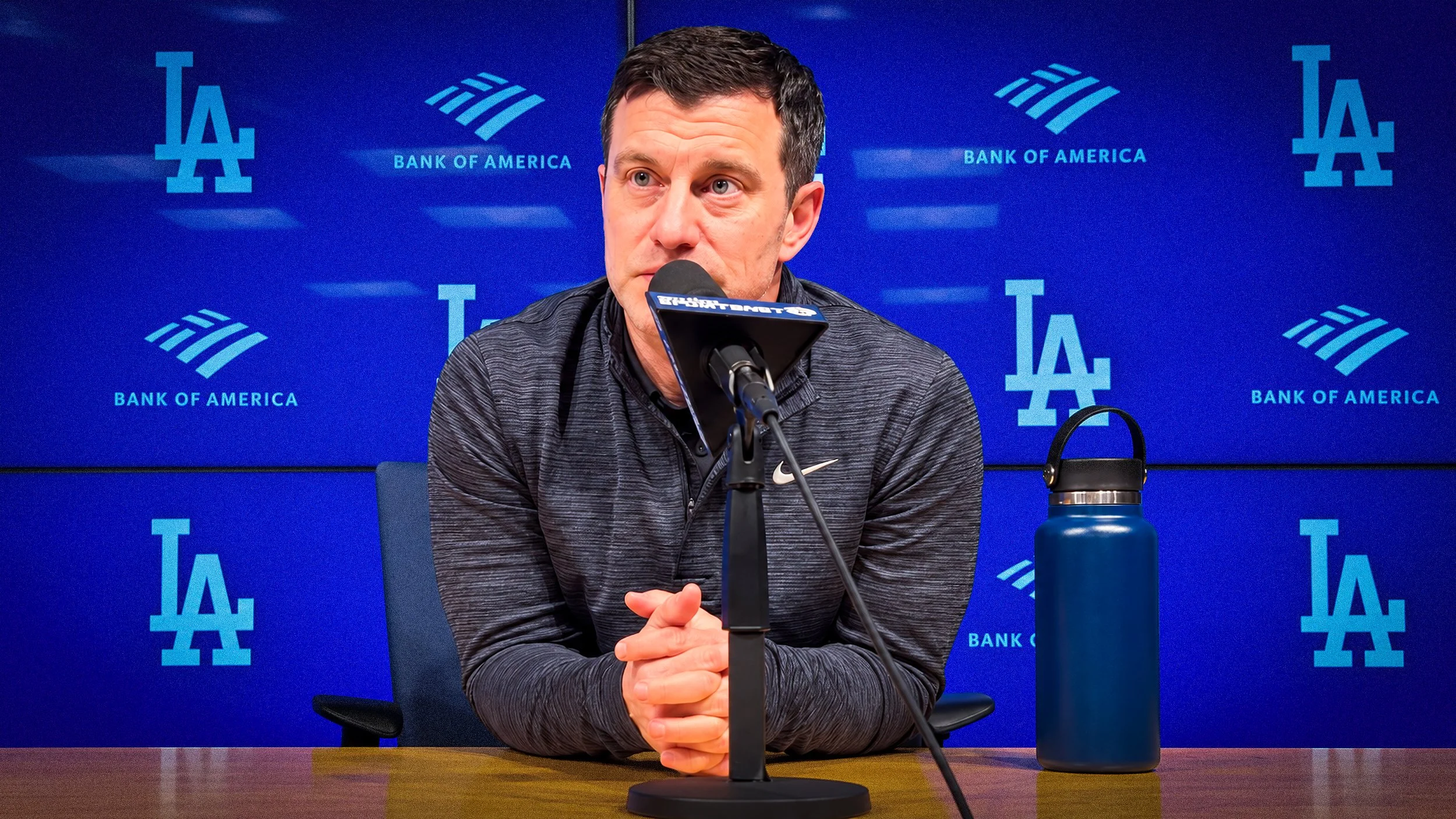
Andrew Friedman is not bothered by suggestions that the Dodgers’ championship window may be closing.
He appears to welcome them.
Asked during the Dodgers’ October 21 season-ending press conference about those declaring the organization’s remarkable run finished, Friedman responded plainly.
“I welcome it,” Friedman said.
The Dodgers’ president of baseball operations described those predictions as outside noise. He said the organization remains focused on its partnership with Dodgers fans and its motivation to bring another championship parade to Los Angeles.
That confidence is understandable for a franchise that won consecutive World Series championships before reaching the 2026 National League Championship Series.
But confidence alone will not answer the questions created by the Dodgers’ disappointing postseason exit.
The challenge now is determining what must change before Los Angeles attempts to begin another championship run.
Why The Questions Are Fair
Calling the Dodgers’ dynasty over after one postseason elimination would be premature.
Los Angeles won 100 games and reached the NLCS despite navigating significant injuries throughout the season. Shohei Ohtani, Mookie Betts, Freddie Freeman, Yoshinobu Yamamoto and Blake Snell remain part of a roster with enough talent to contend again.
The concern is not whether the Dodgers can remain competitive.
It is whether the current version of the roster is still capable of surviving October without meaningful changes.
Milwaukee swept the Dodgers out of the NLCS with a younger, deeper and more athletic roster. Los Angeles received too little production from several of its most important hitters and lacked the dependable position-player depth needed when injuries and fatigue accumulated.
The Dodgers’ lineup is also getting older.
Freeman will play next season at 37. Max Muncy will be 36, Betts will be 34 and Ohtani will be 32. Age does not mean those players can no longer produce, but it increases the importance of workload management, defensive flexibility and dependable alternatives behind them.
Friedman can dismiss declarations that the run is finished while still acknowledging that the roster cannot simply remain unchanged.
Friedman Did Not Promise A Major Signing
Friedman said the Dodgers would feel good about their roster if the season began immediately.
He also made it clear that standing still is never the organization’s approach.
Los Angeles intends to remain aggressive whenever an opportunity arises to increase its talent and improve its championship odds.
That should not be interpreted as confirmation that another superstar is coming.
Friedman did not promise a major free-agent signing, identify a trade target or indicate that the Dodgers intend to reconstruct the roster around one dramatic acquisition.
Being aggressive could mean pursuing an elite player. It could also mean improving the bench, adding defensive versatility, strengthening the bullpen or creating opportunities for younger players.
The Dodgers must determine which approach would make the greatest difference.
Does Los Angeles Need Another Star?
The immediate response to a postseason disappointment is often to pursue the biggest available name.
The Dodgers will undoubtedly evaluate every significant opportunity, as they always do. Adding another star could raise the roster’s ceiling and provide protection against regression or injury.
But a lack of star power was not the defining weakness of the 2026 team.
The Dodgers already had one of baseball’s most talented rosters. Their problems became more apparent when regulars were injured, struggling or unavailable.
Another expensive acquisition would not automatically improve the bench, make the lineup younger or create a path for the organization’s best prospects.
The Dodgers should pursue a major addition if that player materially improves their championship chances. They should not make one merely to create the appearance of responding to their postseason exit.
Better Depth May Be The Greater Need
The Dodgers’ depth has helped sustain their success for more than a decade, but the 2026 season demonstrated the limits of relying on older veterans without enough dependable position-player alternatives.
Los Angeles needs players who can contribute without requiring Dave Roberts to dramatically weaken the lineup whenever a regular needs rest.
That could mean adding a versatile defender, a right-handed bat capable of handling left-handed pitching or a bench player who can legitimately start several times each week.
Those moves would receive less attention than another blockbuster acquisition.
They could prove more important across a 162-game season—and in October.
The Prospects Must Become Part Of The Answer
The Dodgers also possess one of baseball’s deepest collections of position-player prospects.
Josue De Paula demonstrated during his September opportunity that his bat could already affect a major-league lineup. James Tibbs III produced a historic season at Triple-A Oklahoma City. Mike Sirota and other young players continue to move closer.
Friedman has described incorporating that talent as the art of “onboarding” young players.
That process must include more than placing a prospect on the bench.
If the Dodgers want to become younger, they must create meaningful roles and remain patient when those players experience normal developmental struggles.
That does not require dismantling a championship contender or handing jobs to prospects who have not earned them.
It requires constructing a roster on which young players have a realistic path to playing time.
Our Take
The Dodgers do not need to choose only one approach.
They can pursue an impact acquisition, improve their depth and create opportunities for young players. Their resources and farm system give them more flexibility than almost any other organization.
But the objective should not be winning the offseason headline.
It should be building a roster that is younger, deeper and less vulnerable when its veteran stars are injured or struggling.
Friedman has earned the right to remain confident. Since he arrived in Los Angeles, the Dodgers have consistently responded to disappointing endings by finding another way to contend.
The questions surrounding this team are still legitimate.
Now the Dodgers must provide their answer.
Friedman welcomes anyone who believes the Dodgers’ dynasty is ending. Whether Los Angeles needs another superstar, better depth or more opportunities for its prospects will be determined by what he does next—not what he says in October.